The UK strangulation porn ban creates specific criminal offences for possessing or publishing certain pornographic images that explicitly and realistically portray one person strangling or suffocating another. It does not cover every image colloquially described as “choking content.” An image must satisfy all the elements in the enacted legislation, including the objective pornographic-purpose and apparent-reality tests.
The relevant criminal provisions came into force in England and Wales on 6 November 2026. The Crime and Policing Act received Royal Assent on 29 April 2026, but Royal Assent did not activate these offences immediately.
The measures were also added to the Online Safety Act priority-offence framework. This creates a separate concern for regulated platforms, whose systems must address the risk of UK users encountering the illegal content. A moderation decision alone does not prove that someone committed a possession or publication offence.
When and where the new offences commenced
Section 104 of the Crime and Policing Act 2026 inserts section 67A and associated provisions into the Criminal Justice and Immigration Act 2008. The enacted Act records Royal Assent on 29 April 2026.
The Commencement No. 4 Regulations brought section 104(1)–(3) into force on 6 November 2026 only so far as those provisions extend to England and Wales. The related Online Safety Act amendments in section 104(4) and (5) also commenced on that date.
“UK strangulation porn ban” is useful search shorthand, but it does not capture the full territorial position. The cited commencement instrument does not commence section 104(1)–(3) for Northern Ireland. The corresponding Scottish provision in section 105 was still marked prospective in the researched legislation. Operators should record jurisdiction and commencement separately instead of treating the UK-wide headline as the statutory rule.
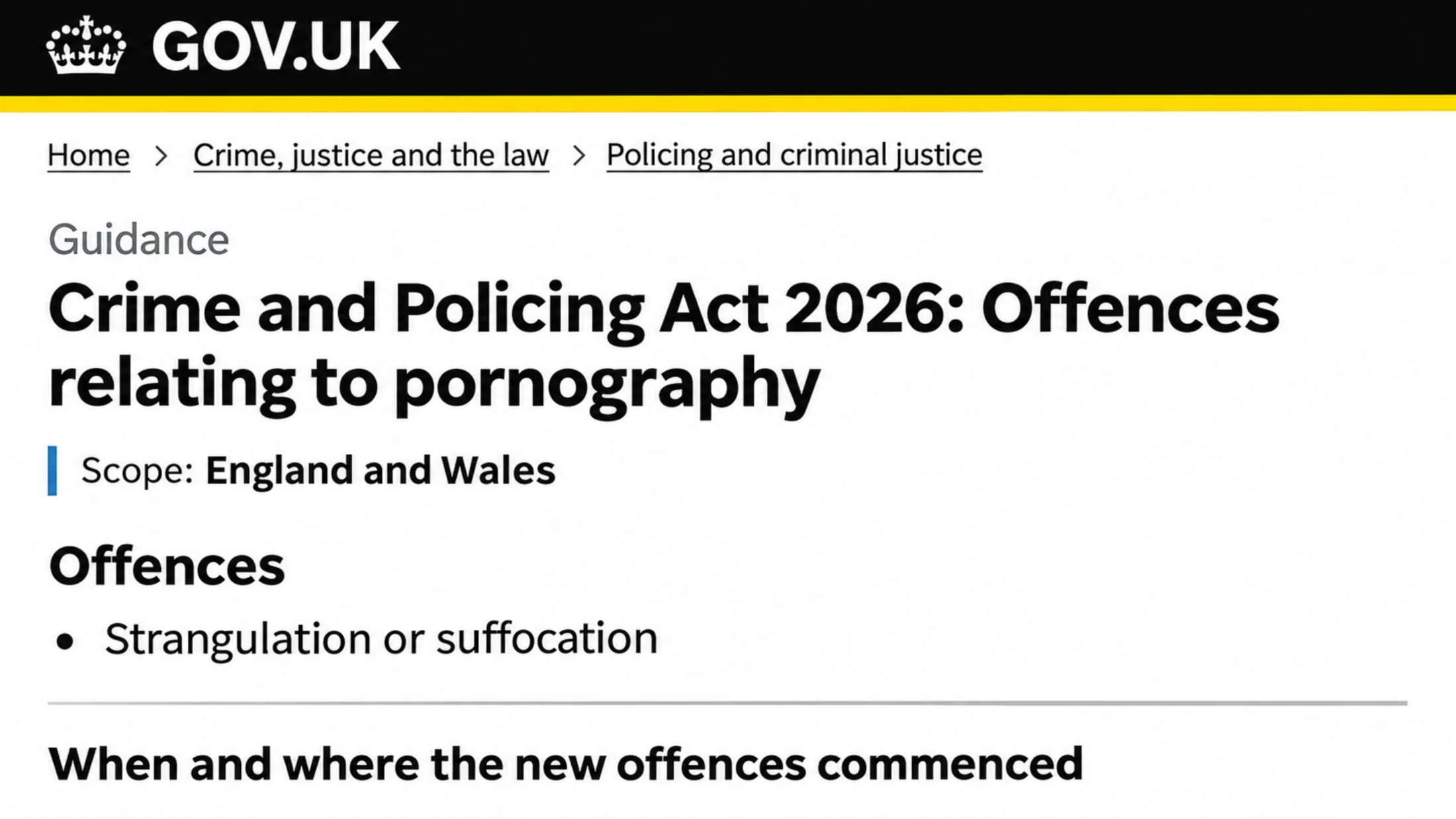
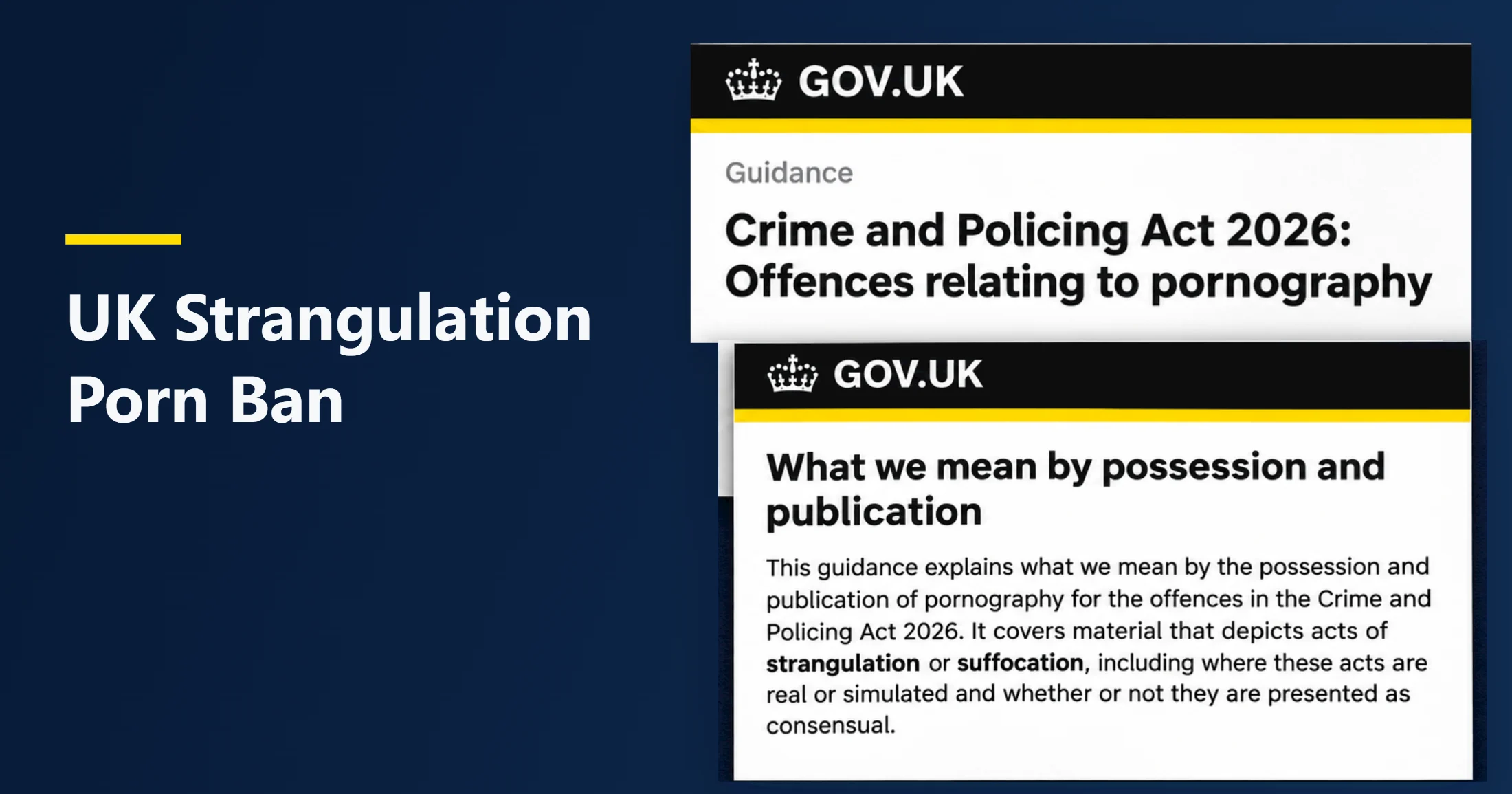
Official GOV.UK guidance identifies the England-and-Wales scope and the strangulation-or-suffocation category.
The section 67A threshold
The controlling wording appears in section 104 of the Crime and Policing Act 2026. For the possession offence, the prosecution must establish a combination of elements. A tag, title or category associated with breath play is not enough on its own.
| Required element | What it means in practice |
|---|---|
| An image | The incorporated definition covers still and moving images produced by any means, along with stored data capable of conversion into an image. |
| Pornographic character | The image’s nature must make it reasonable to assume that it was produced solely or principally for sexual arousal. |
| Explicit and realistic portrayal | It must explicitly and realistically portray an act of strangulation or suffocation by one person on another. |
| Apparent reality | A reasonable person looking at the image must think the people portrayed are real. |
| Possession or publication | The relevant person must possess the image or publish it through conduct covered by the provision. |
The definition of a pornographic image comes from section 63 of the Criminal Justice and Immigration Act 2008. This objective test depends on the nature of the image, rather than the uploader’s private description of it. When an image forms part of a series, the statutory context rules can make the surrounding images relevant to its assessment.
The legislation supplies no special technical definition of “strangulation” or “suffocation.” The official GOV.UK guidance says the terms carry their ordinary meaning and their application to a particular image is a factual question for the court. A broad platform tag such as “choking” can help reviewers locate material for examination; it cannot replace the enacted elements.
The medium provides no automatic exemption. A clip, still frame, preview or thumbnail can be an image if it meets the incorporated definition. Realistic synthetic material can satisfy the apparent-reality element when a reasonable viewer would think the portrayed people were real. At the same time, an image being AI-generated does not establish the other required elements.
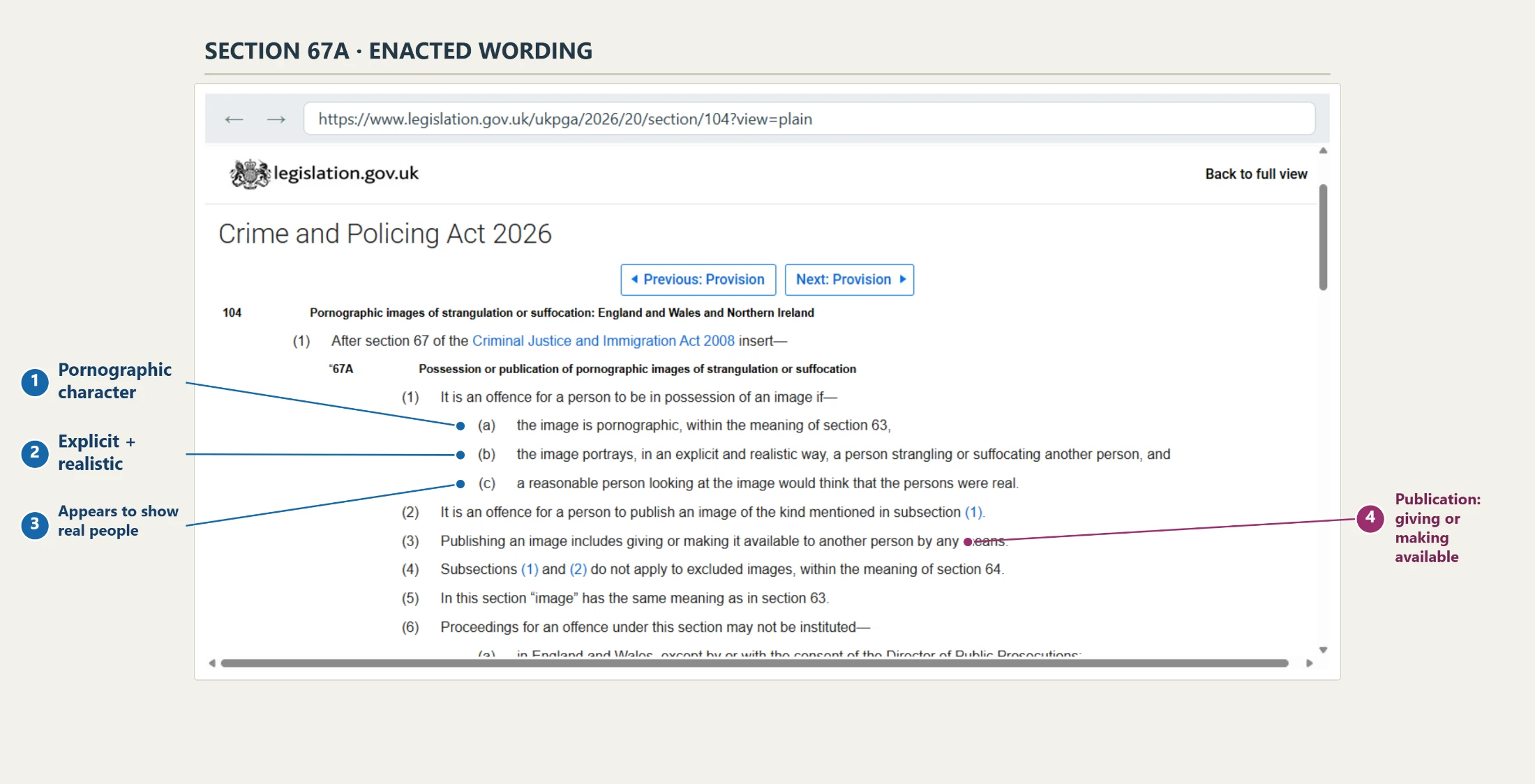
Section 67A sets cumulative conditions for the possession offence and separately defines publication to include giving or making an image available to another person.
Possession: custody or control of a covered image
Section 67A makes possession one route to criminal liability. According to the official guidance, possession generally concerns custody or control. This can include a covered file kept on a device, in a personal account or in cloud storage.
Possession can be continuing conduct. A file acquired before commencement could remain relevant after 6 November simply because the holder continued to possess it. The government’s pre-commencement guidance therefore told people holding covered material to delete it before the provisions took effect.
A site audit needs to reach beyond public posts. Source files, private libraries, downloaded copies, cloud folders, saved moderation samples and other controlled storage locations can all require examination. Browser caches, automated backups and technical queues need individual assessment of custody, control, retention and any applicable intermediary provisions. Automatic system storage and public user access are different technical facts that can raise different statutory questions.
The maximum sentence for possession on indictment is two years’ imprisonment; a fine is also available. Proceedings require the consent of the Director of Public Prosecutions.
Publication: giving or making an image available
Publication is a separate offence. Section 67A expressly includes giving an image to another person or making it available to another person by any means.
Uploading a covered clip, sending it, distributing it, selling access or keeping it available through an account can raise a publication question. The official guidance treats publication as potentially continuing conduct. Removing a public listing may stop future access through that listing, but operators should also examine copies, previews, delivery links and any other locations where the material remains available.
One upload can raise both offences: retaining the file concerns possession, while making it available concerns publication. The elements and available defences still need separate analysis. Publication carries a maximum sentence on indictment of five years, with a fine also available. Prosecution likewise requires DPP consent.
Excluded images and express defences
Section 67A incorporates the excluded-image regime in section 64 of the 2008 Act. The regime concerns images forming part of qualifying classified works. It does not give a blanket exemption to everything that once appeared in a classified film: an image extracted from a classified work solely or principally for sexual arousal can fall outside the exclusion.
The Act also provides express defences, framed as matters for the charged person to prove.
For possession, the defences cover:
- having a legitimate reason for possessing the image;
- not having seen it and neither knowing nor having cause to suspect that it was a relevant image;
- receiving it without requesting it and not keeping it for an unreasonable time; and
- directly participating in the portrayed act where it did not involve non-consensual harm.
For publication, the legitimate-reason defence remains relevant. The participant defence is narrower: the publisher must have directly participated, the act must not have involved non-consensual harm, and the image must have been published only to other people who directly participated.
“Non-consensual harm” uses the meaning supplied through section 66 of the 2008 Act, including harm to which a person did not consent or could not consent in law. Everyday assumptions about consent cannot replace this statutory formulation.
Consensual production or simulation does not create a general exception. Direct participation alone does not authorize commercial distribution to customers. The text also provides no automatic exemption for private accounts, fantasy labels, short clips, thumbnails or euphemistic metadata.
The legislation contains special information-society-service rules for activities such as acting as a mere conduit, caching and hosting. These conditional provisions depend on the service and its role. They do not give every platform or stored copy blanket immunity, and they are separate from the Online Safety Act duties discussed below.
How the statutory elements apply in common situations
A retained downloaded file may raise possession when the holder controls it and the image satisfies every section 67A element. Its filename or category may help with review, but neither proves nor disproves that the image is covered.
An uploaded clip can raise publication because it has been made available to others. The operator should also check generated thumbnails, preview loops, extracted stills and delivery copies. A short duration provides no exemption, although each asset still has to satisfy the statutory test.
When an image arrives without being requested, the possession-specific defence may apply if the recipient does not retain it for an unreasonable time. Prompt deletion and a reliable report-and-remove process are therefore operationally important.
A participant-to-participant share is not automatically outside the offence. The specific publication defence requires direct participation, no non-consensual harm and publication only to other direct participants. Wider distribution presents a materially different fact pattern.
A realistic synthetic image cannot be dismissed solely because no camera recorded the scene. The apparent-reality question is whether a reasonable viewer would think the portrayed people were real. The pornographic-purpose and portrayal elements must also be present.
“All choking imagery is banned” is therefore an unreliable summary. Claims that an image was consensual, private or only a thumbnail also cannot substitute for applying the enacted wording.
Priority-offence status under the Online Safety Act
Section 104 adds possession or publication of the relevant images to Schedule 7 of the Online Safety Act 2023 as priority offences. The government’s pornography factsheet presents this as part of its response to illegal material online.
For regulated user-to-user and search services, priority status makes the issue one of service design and risk management. Under Ofcom’s illegal-content framework, applicable services must assess relevant risks and use proportionate systems intended to prevent UK users from encountering priority illegal content. Controls can include detection and moderation processes, prompt handling of identified material, reporting routes, complaints procedures and appropriate records.
That framework does not rewrite section 67A. A platform may prohibit a broader category because automated tools cannot reliably resolve every statutory element, its own terms are stricter, or conservative moderation is operationally simpler. The resulting restriction is a platform decision, not a court finding that every removed item was criminal.
Geo-restricting UK access may form part of a service response, but it is not a universal solution. Operators must separately examine whether material remains published elsewhere, whether they possess controlled copies in England or Wales, and whether their Online Safety Act controls are adequate.
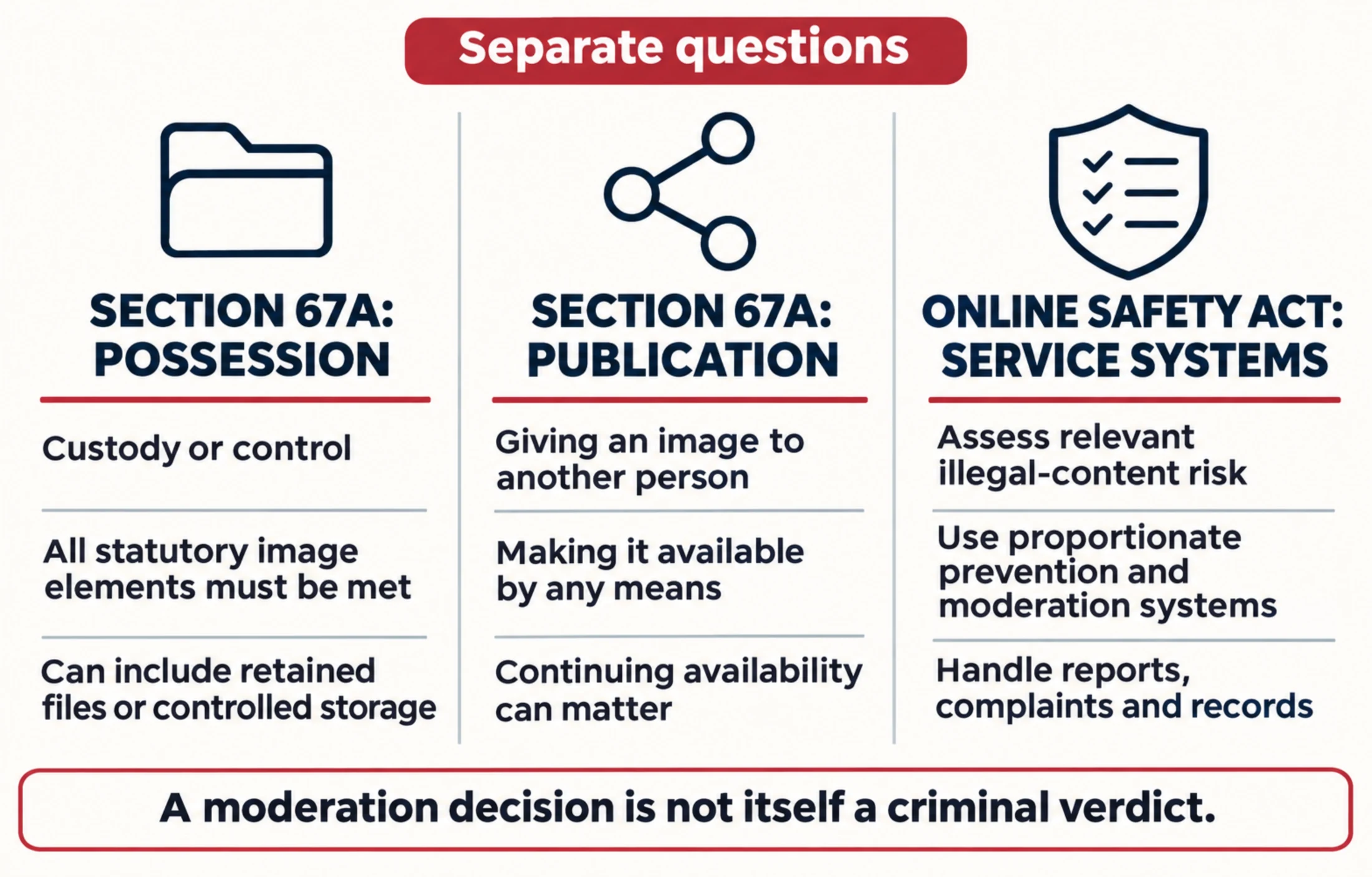
Possession, publication and regulated-platform systems raise separate legal and operational questions; a moderation decision is not itself a criminal verdict.
A content-operations playbook for sites and creators
The practical response should cover existing libraries and new uploads.
Inventory originals and derivatives. Locate full videos, clips, stills, thumbnails, previews, source files, cloud copies, CDN variants, cached assets and moderation-queue copies. Record who controls each location and where the material remains accessible.
Classify against the enacted elements. Review whether the asset is an image under section 63, is objectively pornographic, explicitly and realistically portrays the specified act, and shows people whom a reasonable viewer would think real. Use category tags to locate candidates, not to make the final determination.
Choose and record a disposition. Mark the material as a clear non-match, remove or restrict it where required, or escalate it for human review. Check public availability and retained copies before closing a case; removing the listing may leave other copies accessible or under the operator’s control.
Review UK access controls. Test geo-restrictions from the user-facing side and inspect direct links, embeds, search results, previews and cached delivery paths. Record what each restriction covers and what remains unaffected.
Update upload rules and metadata. Describe the prohibited category in language that reviewers and uploaders can apply. Require accurate titles and tags. Euphemistic metadata intended to bypass filters makes classification less reliable and should trigger escalation.
Train reviewers with element-based examples. Reviewers need to distinguish a discovery flag from a legal conclusion. Training should cover the pornographic-purpose test, explicit and realistic portrayal, apparent reality, classified-work extracts and the narrow participant defences.
Keep an audit trail. Preserve the asset identifier, reviewer decision, applicable elements, access change, takedown time, escalation, appeal and later review. These records help show that controls operate consistently without treating every initial flag as confirmed illegality.
Creators should perform the same checks before uploading or travelling with an existing media library. That includes source files and cloud accounts, not only material currently displayed on a profile.
Permission-based upload controls are useful outside adult-platform operations as well. Mimisy’s privacy and safety page illustrates controls around permitted uploads, private media handling, account safeguards and deletion. Its terms show how content rules and account responsibilities can be stated at service level. Mimisy is not presented as a pornography platform or as an authority that determines whether an image violates section 67A.
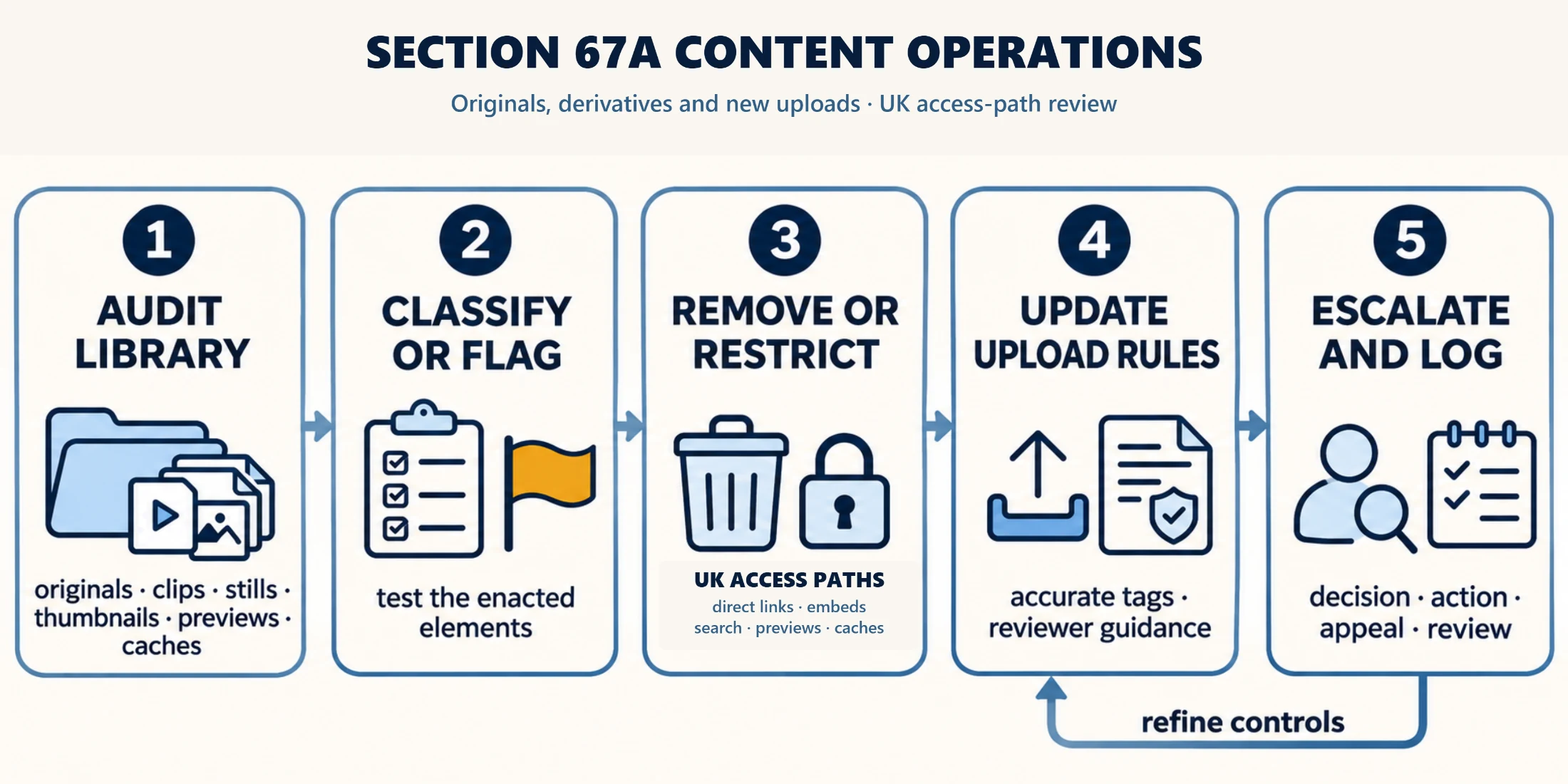
A repeatable workflow for reviewing originals, derivatives and new uploads, including direct links, embeds, search results, previews and caches.
What operators should do now
Confirm the commencement and territorial position relevant to the service. Apply the enacted elements instead of relying on “choking porn ban” headlines. Audit existing originals and derivatives, remove or restrict affected material, revise upload and reviewer controls, test UK access measures, and document decisions and escalations.
Exact outcomes can turn on the facts and the enacted wording. When the cumulative section 67A test does not produce a clear answer, send the asset for informed human review. A category name, consent claim, format or platform action cannot supply that answer on its own.
For an example of how a photo-to-video product states permission-based upload rules and account controls without presenting itself as an adult-content platform, see Mimisy's privacy and safety page.
Find an effect for your next idea.
Browse the actual previews, choose your settings, and review the credit quote before you create.
Explore effects →