
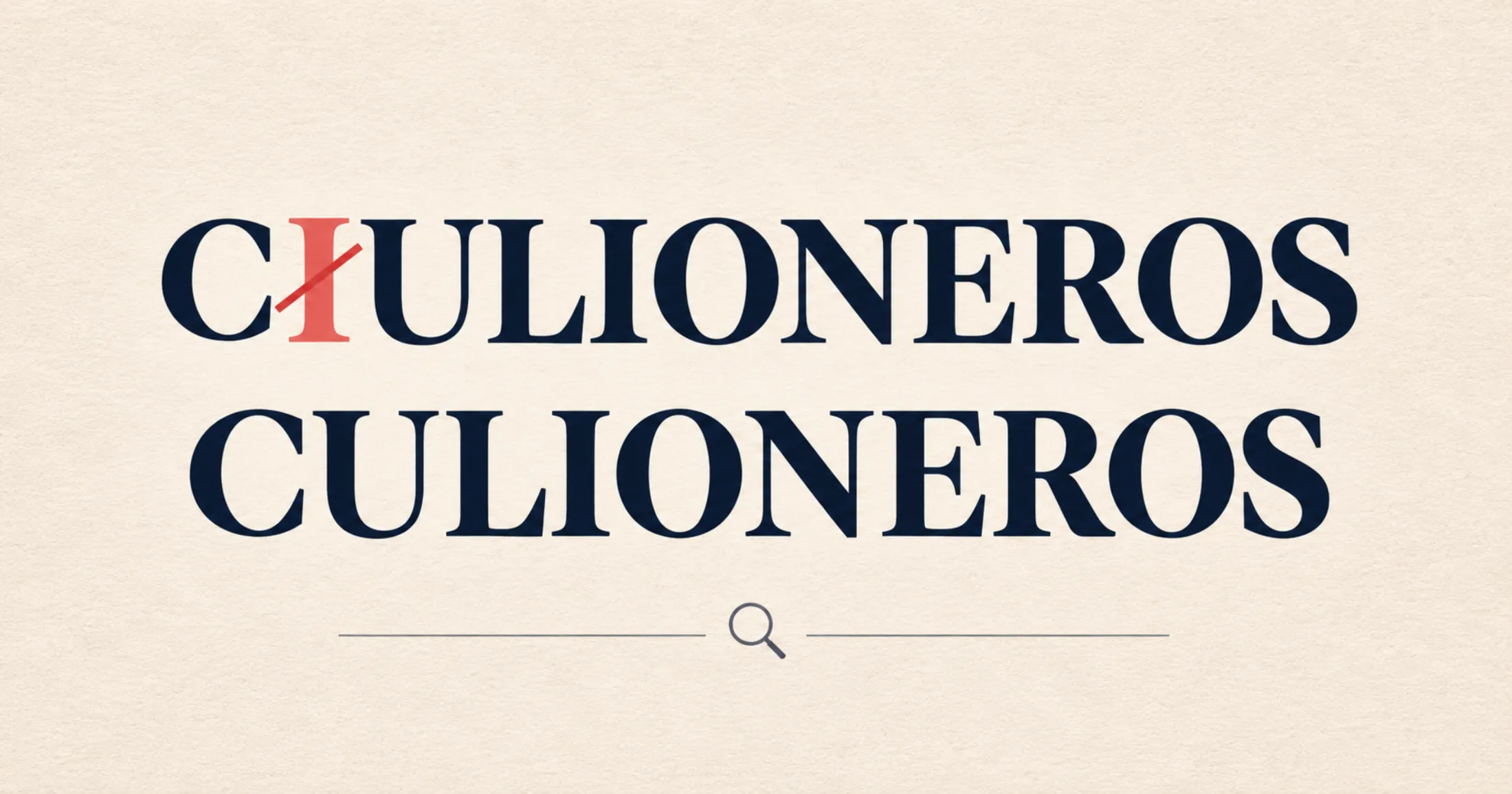
Ciulioneros is most likely a misspelling or search variation of Culioneros, the documented name of a Spanish-language adult entertainment brand associated with Bang Bros and productions in Colombia. No reliable evidence establishes Ciulioneros as a separate brand, standard Spanish word, cultural tradition, folklore concept, or recognized community.
The evidence trails for the two spellings are markedly different. Culioneros appears in Colombian journalism from 2012, later reporting by El Espectador, and a US trademark record. Ciulioneros, with an extra i, appears mainly in recent search-oriented articles that give conflicting explanations. Depending on the page, it is described as slang, a culture, a creative movement, a folklore tradition, or an online identity—usually without a traceable origin for any of those meanings.
The altered spelling’s exact origin is unknown. It could have started as a typing error, an autocomplete variation, or a deliberate respelling, but no reliable record identifies the first user or explains why the extra letter appeared.
Ciulioneros vs Culioneros: the one-letter difference
The distinction is easy to miss in search results:
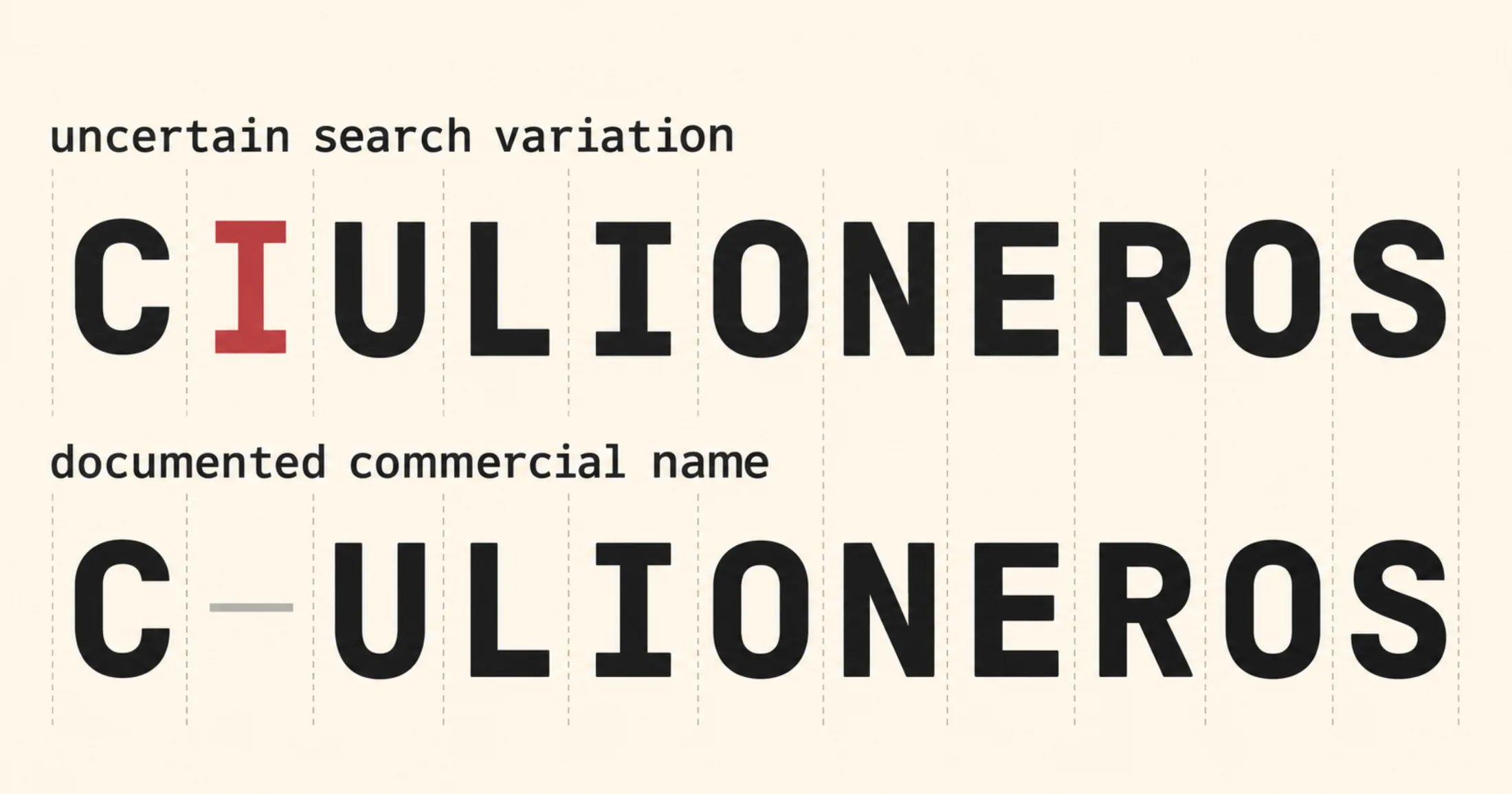
- CIULIONEROS: C + I + U + LIONEROS
- CULIONEROS: C + U + LIONEROS
An extra I after the initial C is the only spelling difference, yet it leads to two very different sets of search results.
| Question | CIULIONEROS | CULIONEROS |
|---|---|---|
| Exact spelling | Contains an extra I between C and U | Does not contain that I |
| Standard Spanish word? | Not reliably documented | Not established here as a standard dictionary word |
| Independent brand record? | No reliable record identified | Documented commercial name and registered US mark |
| Historical reporting? | No established early reporting identified | Appears in Colombian reporting from 2012 and 2016 |
| Most likely search role | Misspelling, altered spelling, or query variation | The name generally intended when researching the documented brand |
| Evidence quality | Recent, contradictory secondary claims | Dated journalism and trademark records |
This cannot prove that everyone typing Ciulioneros intended to search for Culioneros. It does show that Culioneros has a traceable history that the altered spelling lacks.
Is Ciulioneros a Spanish word, brand, culture, or community?
There is no strong evidence that Ciulioneros is a standard Spanish word. The Real Academia Española entry for culo documents the Spanish noun and its Latin origin, but a similar-looking construction does not automatically become an accepted derivative. Words can follow familiar Spanish spelling patterns without appearing in established dictionaries or having stable usage among Spanish speakers.
No reliable independent brand record has been identified for Ciulioneros, either. The relevant commercial documentation uses CULIONEROS.
Descriptions of Ciulioneros as a culture, community, folklore tradition, cuisine, artistic movement, or shared identity also lack adequate support. A credible cultural history would ordinarily include some combination of:
- A named community or identifiable group that uses the term
- A location and history traceable over time
- Dated primary documents, archives, or contemporary reporting
- Testimony from participants rather than anonymous summaries
- Scholarly, museum, linguistic, or institutional research
- Consistent usage across independent sources
Recent pages making broad cultural claims generally provide none of this. They may concede that the term has no agreed definition, then associate it with creativity, belonging, tradition, fashion, performance, or Latin American heritage. Those themes do not establish a documented history simply because they sound coherent when placed together.
Why typo keywords can look established online
Pages can begin targeting a search term before that term has a recognized meaning. A simple feedback loop may then make an unsupported spelling appear established:
- Someone enters a variation. A user mistypes a word, remembers it incorrectly, or copies an earlier error.
- Search systems detect interest. Autocomplete, related-query tools, and publisher analytics may surface the altered form as more people encounter it.
- Publishers notice an unanswered query. A term with visible interest and little authoritative coverage becomes an easy topic to target.
- An explanation is copied or expanded. Later pages repeat a claim, paraphrase it, or combine several speculative accounts.
- Additional indexed pages create apparent legitimacy. Readers see multiple results and mistake them for independent confirmation.
- Those pages prompt further searches. Their headlines and summaries introduce more people to the same spelling.
This model explains how typo keywords can spread in general. It does not establish how Ciulioneros originated, and no verified first user, publication date, or transmission path has been found for the spelling with the extra I.
It also shows why result counts are a poor test of legitimacy. Ten articles may ultimately depend on one unsupported statement. Repetition raises visibility but cannot create an etymology or cultural history.
Adult-platform terminology is particularly susceptible to this effect because brand names, product features, marketing labels, and third-party descriptions can easily be mixed together. Mimisy’s guide to how adult-platform features can be misunderstood shows why a label needs to be interpreted in its actual product context rather than through its wording alone.
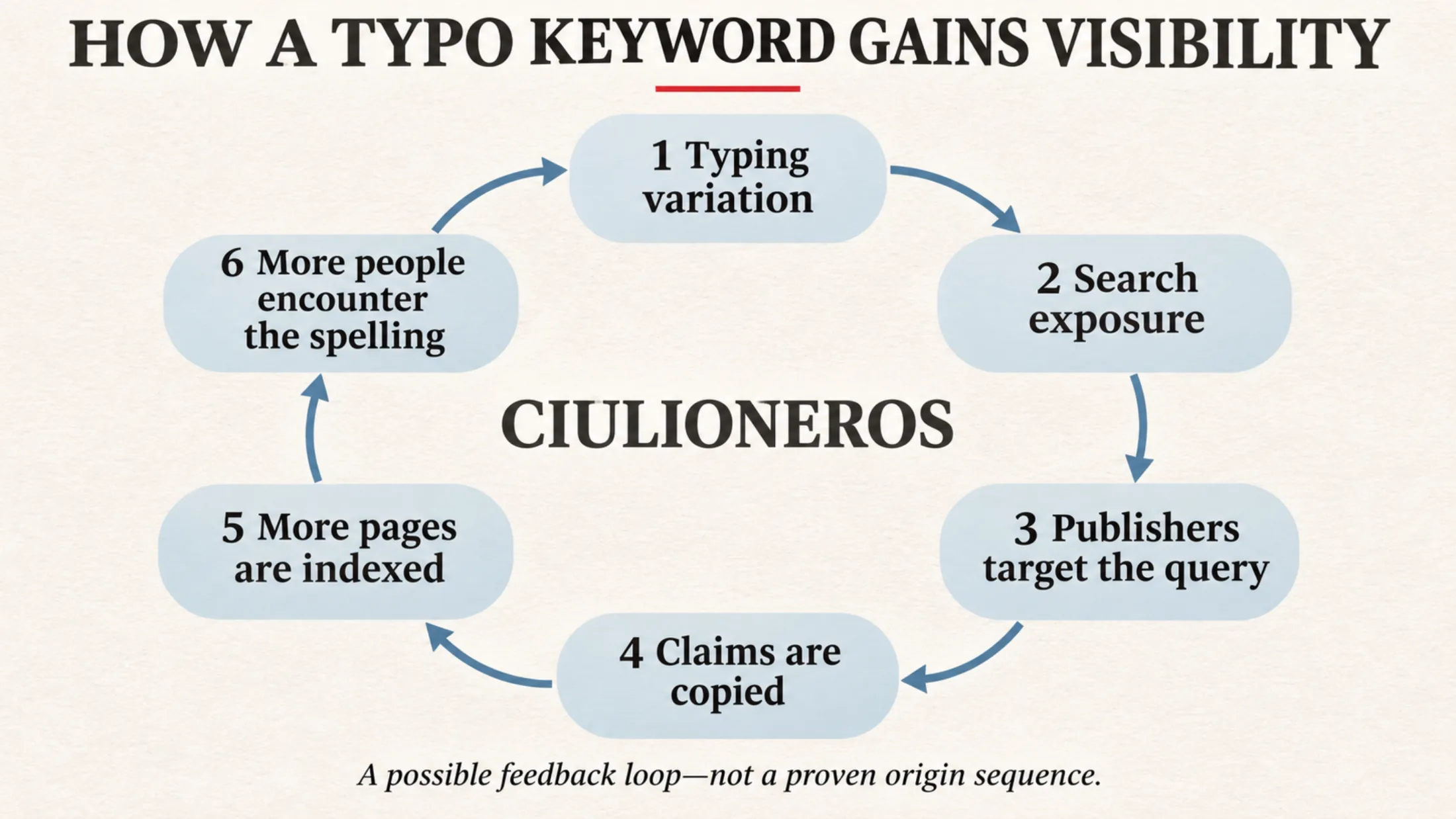
A possible feedback loop can increase an uncertain spelling’s visibility, but repetition and indexing do not prove its origin or meaning.
What the historical record says about Culioneros
The record for Culioneros is much clearer.
In June 2012, Colombian newspaper La Patria used the Culioneros name while reporting on controversial productions filmed at recognizable locations in Cali. Its publication date establishes that Culioneros appeared in contemporary journalism more than a decade before the recent cluster of Ciulioneros explainers.
A US trademark application for CULIONEROS was filed on April 18, 2012, under serial number 85601858. The mark was registered on October 30, 2012, as registration number 4234165. Its listed services concern a website presenting adult-oriented photographic, audio, video, and prose material. The record is available through Justia’s trademark-record interface, Furm’s presentation of the filing, and the August 14, 2012 USPTO Trademark Official Gazette.
The filing lists claimed first use anywhere on April 26, 2011, and claimed first use in commerce on December 31, 2011. These are claims recorded in the trademark filing, not independently verified dates for the term’s creation. They also provide no evidence about when Ciulioneros first appeared.
The filing gives “ladies’ men” as an English translation of Culioneros. That wording belongs to the trademark record and should not be treated as a universal dictionary definition for either spelling.
In 2016, El Espectador published a retrospective report on Colombia’s adult-production industry. It described Culioneros as the Spanish-language version associated with Bang Bros and discussed its use of Spanish, Colombian expressions, local settings, and localized production formats.
The available record supports this cautious timeline:
| Date | Documented event | What it establishes |
|---|---|---|
| April 26, 2011 | Claimed first use anywhere in the trademark record | A claim recorded in the filing, not independent proof of origin |
| December 31, 2011 | Claimed first use in commerce | Another filing claim concerning CULIONEROS |
| April 18, 2012 | Trademark application filed | An official commercial record using the exact CULIONEROS spelling |
| June 20, 2012 | La Patria report published | Contemporary Colombian reporting using the Culioneros name |
| October 30, 2012 | US registration issued | Registration 4234165 for the exact mark and listed services |
| March 17, 2016 | El Espectador report published | Retrospective reporting on the brand association and Colombian production context |
None of these entries reveals where Ciulioneros came from. They establish that Culioneros is the spelling supported by historical commercial and journalistic records.
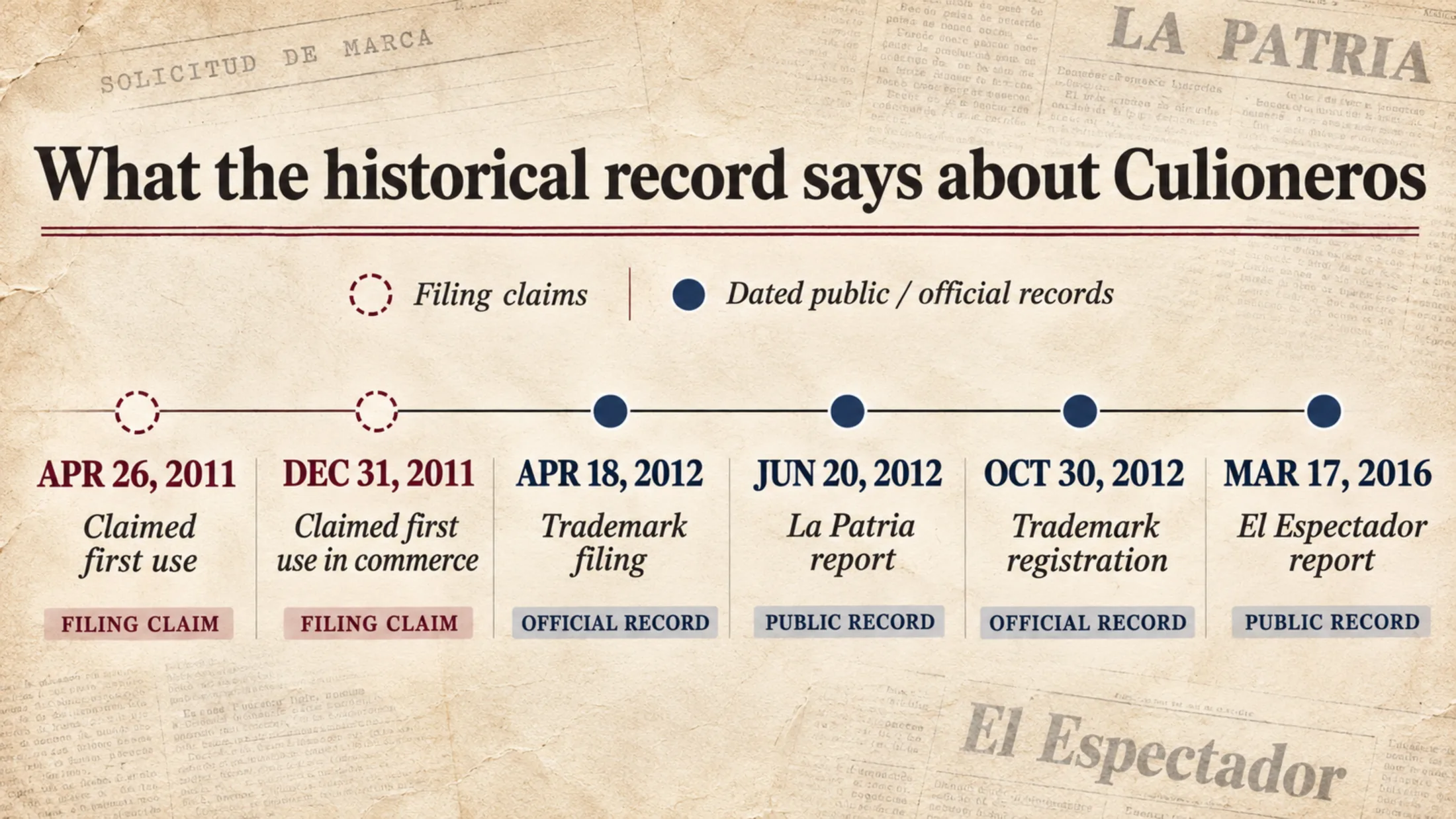
Dashed markers denote first-use claims recorded in the trademark filing; solid markers denote dated official or published records.
Fact, inference, and unsupported narrative
Separating three evidence levels helps keep a reasonable conclusion from becoming an invented certainty.
| Evidence level | Example | Appropriate conclusion |
|---|---|---|
| Verified record | Newspapers and trademark materials use CULIONEROS | Culioneros is a historically documented commercial name |
| Reasonable inference | CIULIONEROS differs by one inserted I and lacks an equivalent record | It is most plausibly a misspelling or search variation of Culioneros |
| Unsupported assertion | Ciulioneros is described as ancient folklore, a cultural movement, or an established community | Do not accept the claim without traceable historical or community evidence |
The trademark record has a narrow but useful role. It documents an exact commercial mark and specified services. It does not establish Culioneros as a standard dictionary word, settle every possible translation, or explain why someone later typed Ciulioneros. Trademark records address marks and commercial categories, not universal linguistic meaning.
Source type matters just as much when researching platform terminology. First-party rules, historical records, and independent reporting answer different questions. Mimisy’s explanation of the difference between platform rules and online summaries offers a related example: a confident third-party description is not equivalent to a platform’s own defined category.
How to evaluate lookalike search results
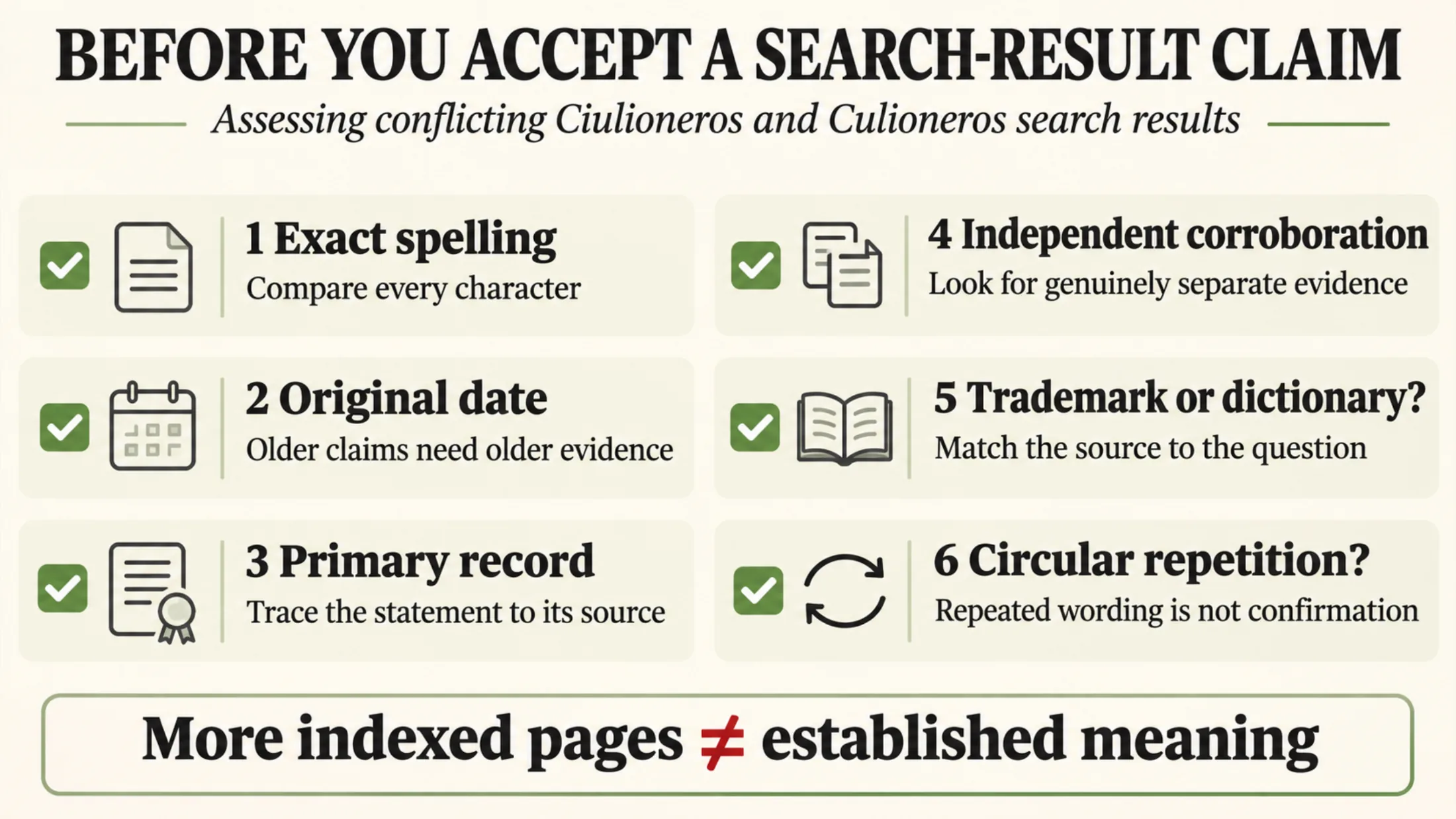
When sources disagree about an unfamiliar term, use this six-part check:
- Compare the exact characters. Search both Ciulioneros and Culioneros instead of relying on the spelling shown in one headline.
- Check the dates. A 2012 newspaper report proves that a spelling was used at that time. A 2026 explainer cannot establish an older origin merely by describing one.
- Trace claims to their source. Follow statements about history, language, or registration back to newspapers, dictionaries, official records, or identifiable participants.
- Match the source to the question. A trademark database can document a commercial mark, while a dictionary can document standardized vocabulary. Neither source automatically proves folklore or community identity.
- Look for independent corroboration. Several pages repeating similar wording may form a circular content cluster rather than provide separate evidence.
- Do not equate result volume with legitimacy. Search engines index published pages; they do not certify the claims within them.
Suppose a result describes Ciulioneros as a digital cultural movement combining art, fashion, masked performance, and Latin American heritage. Before accepting that account, look for a named community, a location, early dated examples, participant testimony, or institutional research. Without them, the detailed description remains an unsupported claim.
The trademark record offers a useful contrast. It supplies an exact spelling, serial number, registration number, filing date, service description, and claimed-use dates. Its scope is limited, but each claim is traceable. It supports Culioneros as a documented commercial name; it does not support an elaborate Ciulioneros culture.
This method reflects Mimisy’s emphasis on trust and transparency: determine what a source establishes, keep the interpretation within that boundary, and state when the available record leaves a question unresolved.
What to search for next
To research the historically documented adult entertainment brand, search for Culioneros without the extra I. Useful follow-up queries include the exact trademark serial number 85601858, registration number 4234165, and the brand name paired with the dates or Colombian publications listed above. These searches can address the historical question without opening or linking to explicit media.
For now, Ciulioneros is best understood as a likely misspelling or search variation. Its precise origin remains unknown, and the available evidence does not support treating it as a separate Spanish word, brand, folklore tradition, culture, or established community. Ciulioneros is the uncertain spelling; Culioneros is the documented name.
Find an effect for your next idea.
Browse the actual previews, choose your settings, and review the credit quote before you create.
Explore effects →