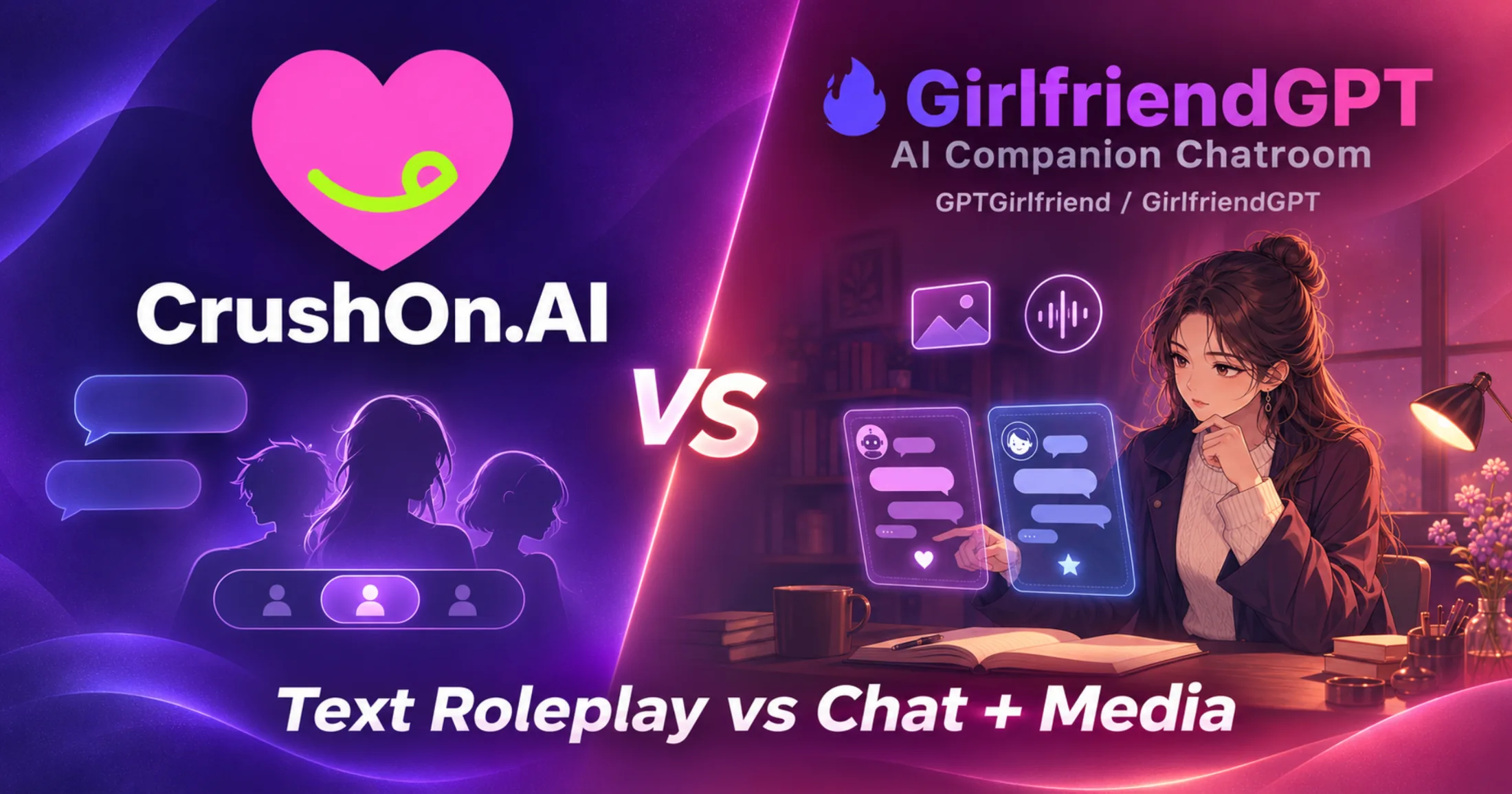
CrushOn.AI is the stronger documented choice for selectable AI models, detailed text-roleplay controls, context and memory options, a large character library, and group chat. GPTGirlfriend—now branded mainly as GirlfriendGPT—better suits people who want adult character chat, image generation, selfies, voice, and visual roleplay in one ecosystem.
Neither platform is better for everyone. This comparison focuses on their documented product structures and features; no independent head-to-head response-quality benchmark was supplied. Writing style, image aesthetics, voice quality, and character chemistry are subjective, so trying the available free access will tell you more than a universal score.
GPTGirlfriend or GirlfriendGPT: why both names appear
The official domain is gptgirlfriend.online, but the current site prominently uses the GirlfriendGPT name while retaining GPTGirlfriend in its domain and some product copy. “GPTGirlfriend/GirlfriendGPT” refers to the same service throughout this guide.
CrushOn.AI continues to use its established name on the official platform page.
CrushOn.AI vs GPTGirlfriend at a glance
| Decision point | CrushOn.AI | GPTGirlfriend / GirlfriendGPT |
|---|---|---|
| Best documented fit | Model choice, configurable text roleplay, longer scenes, context options, and group chat | Adult chat combined with images, selfies, voice, and visual roleplay |
| Free access | Official page currently advertises unlimited chat on free models plus 100 monthly credits for Pro models | Official terms describe limited free messaging; check the live account offer |
| Paid structure | Tiered subscriptions and credits, with consumption affected by model and context choices | Paid credits and subscriptions; verify exact prices and media allowances at checkout |
| Character discovery | Large creator-driven library, currently advertised at more than eight million characters | Community-created character discovery closely connected to visual interaction |
| Character creation | Personality, greeting, scenario, example dialogue, appearance, and visibility controls | Custom character creation integrated with the broader chat-and-media ecosystem |
| Selectable models | A visible part of the product, including free and paid model categories | No equivalent public model-selection layer is clearly documented on the accessible homepage |
| Context and memory | Model-dependent context plus separate history and saved-memory concepts | Continuity features are part of the experience, but public documentation exposes fewer model-level tradeoffs |
| Group chat | Documented multi-character group chat | Not a central documented differentiator |
| Images and selfies | Available capabilities may vary, but media is not the main documented distinction | Integrated generation and AI selfies are central features |
| Voice | Voice options are documented | Voice chat is a prominent documented feature |
| Mobile access | Web/mobile continuity, with iOS home-screen and Android APK guidance | Mobile web/PWA installation and an Android APK are documented |
| Moderation | Adult-oriented use remains subject to current platform rules and visibility controls | Adult-only service with published restrictions and human/automated review |
| Privacy questions | Check chat, memory, character, media, and deletion controls | Check the same areas, including published retention and user-content terms |
Features, credit rules, and plan conditions can change. Use the table as a starting point, then verify the current checkout before paying.
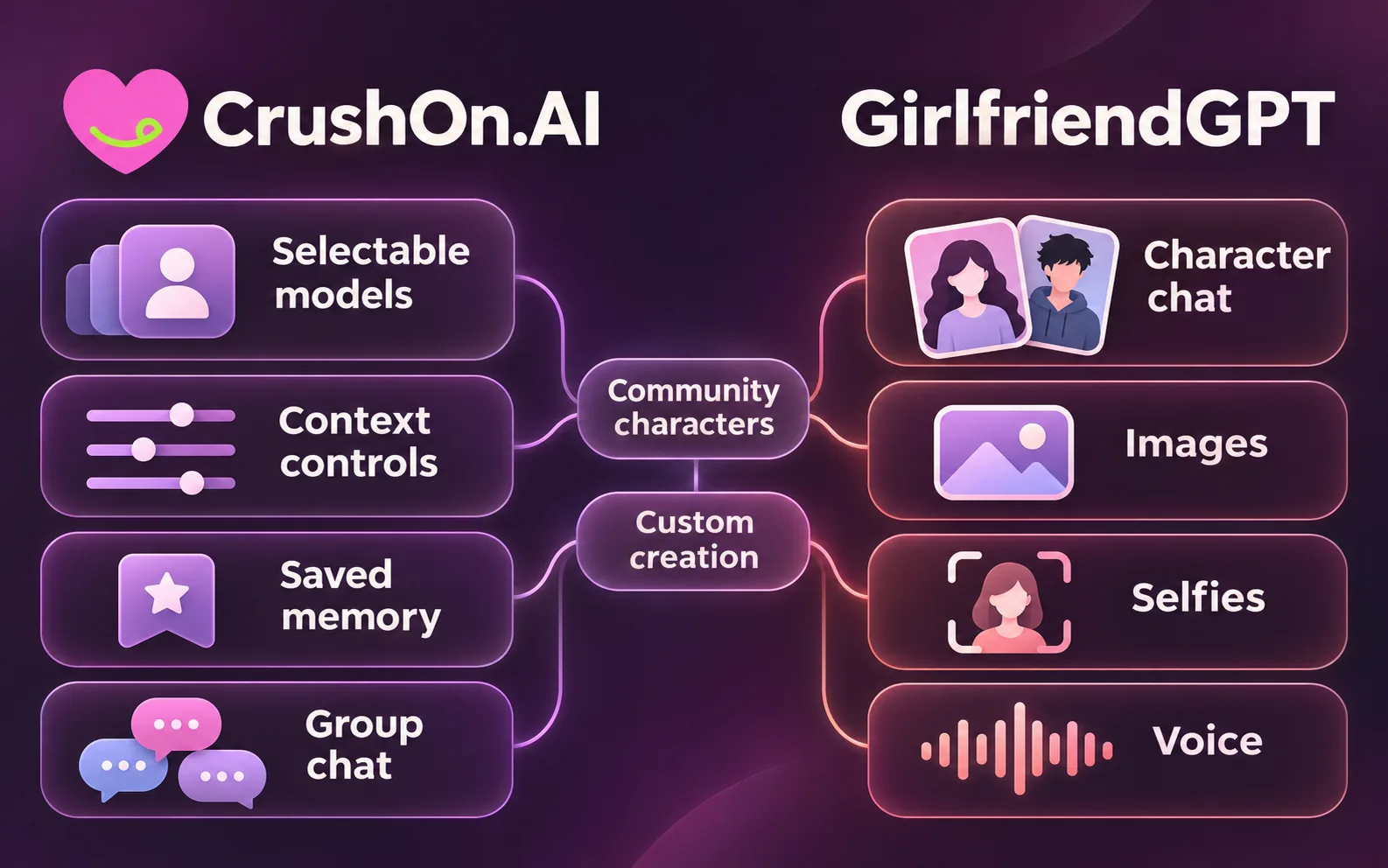
CrushOn.AI foregrounds model, context, memory, and group-chat controls, while GirlfriendGPT connects character interaction with images, selfies, and voice.
What CrushOn.AI is built around
CrushOn.AI is primarily a text-roleplay platform with model selection and granular controls. Its community library provides many ready-made characters, but its main distinction becomes clearer after you choose one.
Users can select free or paid model categories, switch models, and balance model access, context capacity, and credit consumption. Those choices accommodate different uses: one person may want quick, casual exchanges, while another needs a long-running story with detailed instructions and recurring plot points.
The platform also separates several concepts that comparison tables often group together as “memory”:
- Chat history is the visible record of earlier messages.
- Context is the portion of the conversation and instructions available to the model as it prepares a reply.
- Saved or pinned memory preserves selected facts so they can be reintroduced beyond the immediate exchange.
CrushOn.AI also documents multi-character group chat, making it a practical option for ensemble scenes. For example, a reader could put a protagonist, rival, and supporting character in the same room instead of manually writing every secondary role.
Its official page currently advertises unlimited chatting with free models and 100 monthly credits for Pro models. Those figures are time-sensitive. Unlimited free-model messaging does not necessarily include every model, context setting, or voice feature, so check the active model and credit estimate before starting a long thread.
What GPTGirlfriend/GirlfriendGPT is built around
GirlfriendGPT combines adult character chat with integrated media features. Its homepage highlights unfiltered adult roleplay, community characters, custom character creation, AI-generated selfies, integrated image generation, and voice chat.
Visuals form part of the character relationship and scene. A conversation can lead to a requested selfie or generated image, allowing the character’s appearance to continue through the interaction. This approach suits readers who want roleplay to blend writing, character imagery, and voice instead of revolving mainly around a long text thread.
Its standalone creation controls also reflect an interest in visual production, with options such as prompts, negative prompts, styles, quantity, creativity, and safe-mode settings. Readers focused on visual workflows may find Mimisy’s comparison with Fapify useful for seeing how dedicated image-and-video creation differs from a persistent companion relationship.
Community characters remain important to GirlfriendGPT, but the platform connects them more closely to visual output. This also differs from services built around licensed real-person personas. Mimisy’s OhChat Pornstar Mode explainer describes that separate creator-persona model, which should not be confused with an open library of fictional community characters.
Character discovery and creation
Both services offer more than a small collection of official personalities, but their documented priorities differ.
CrushOn.AI emphasizes library scale and creator-controlled roleplay definitions. Its creation guidance includes fields for personality, greeting, scenario, appearance, and example dialogue, along with public, unlisted, and private visibility choices. These fields shape the character, the opening of the conversation, and the style the model should imitate.
GirlfriendGPT focuses on characters that can participate across chat, selfies, images, and voice. For someone interested in visual roleplay, appearance consistency and media integration may matter more than choosing the underlying language model.
Before investing time in either character creator, inspect:
- Which definition fields are public, hidden, or reusable by others.
- Whether a character can be private, unlisted, or fully discoverable.
- Whether visibility can be changed after publication.
- How greetings, example dialogue, scenario instructions, and appearance prompts interact.
- Whether a character and its associated media can be edited or deleted.
- What the terms say about uploaded images, definitions, and generated outputs.
A large library increases the chance of finding a niche concept, but it does not guarantee a well-written character. Read the description and opening message, then run a short scene before spending credits on a lengthy conversation.
Text roleplay, context, and memory
Context is the working material the AI can consider for its next reply. It may contain recent messages, character instructions, scenario information, and saved facts. Memory usually refers to information retained or retrieved separately to support continuity over a longer interaction.
A larger context allowance can help preserve tone, relationships, and recent events, but it cannot guarantee perfect recall. Important details may compete with long stretches of dialogue, instructions can conflict, and different models may interpret the same memory differently.
CrushOn.AI exposes these tradeoffs by connecting model selection, context options, and credit use. That visibility suits readers who want to adjust how the roleplay works. One practical test is to introduce three harmless details—a preferred nickname, a location, and a future plan—continue the scene for a while, and check whether the selected model uses them naturally. Run the test on the model and context setting you might actually buy.
GirlfriendGPT’s accessible public presentation concentrates on the finished character experience rather than the underlying models. Do not assume that it provides a model-selection layer equivalent to CrushOn.AI unless the current signed-in interface shows one.
Readers comparing visual creation with open-ended character conversation can also consult Mimisy vs SpicyChat. It explains why a tool for producing reusable media is not automatically interchangeable with a text-first roleplay platform.
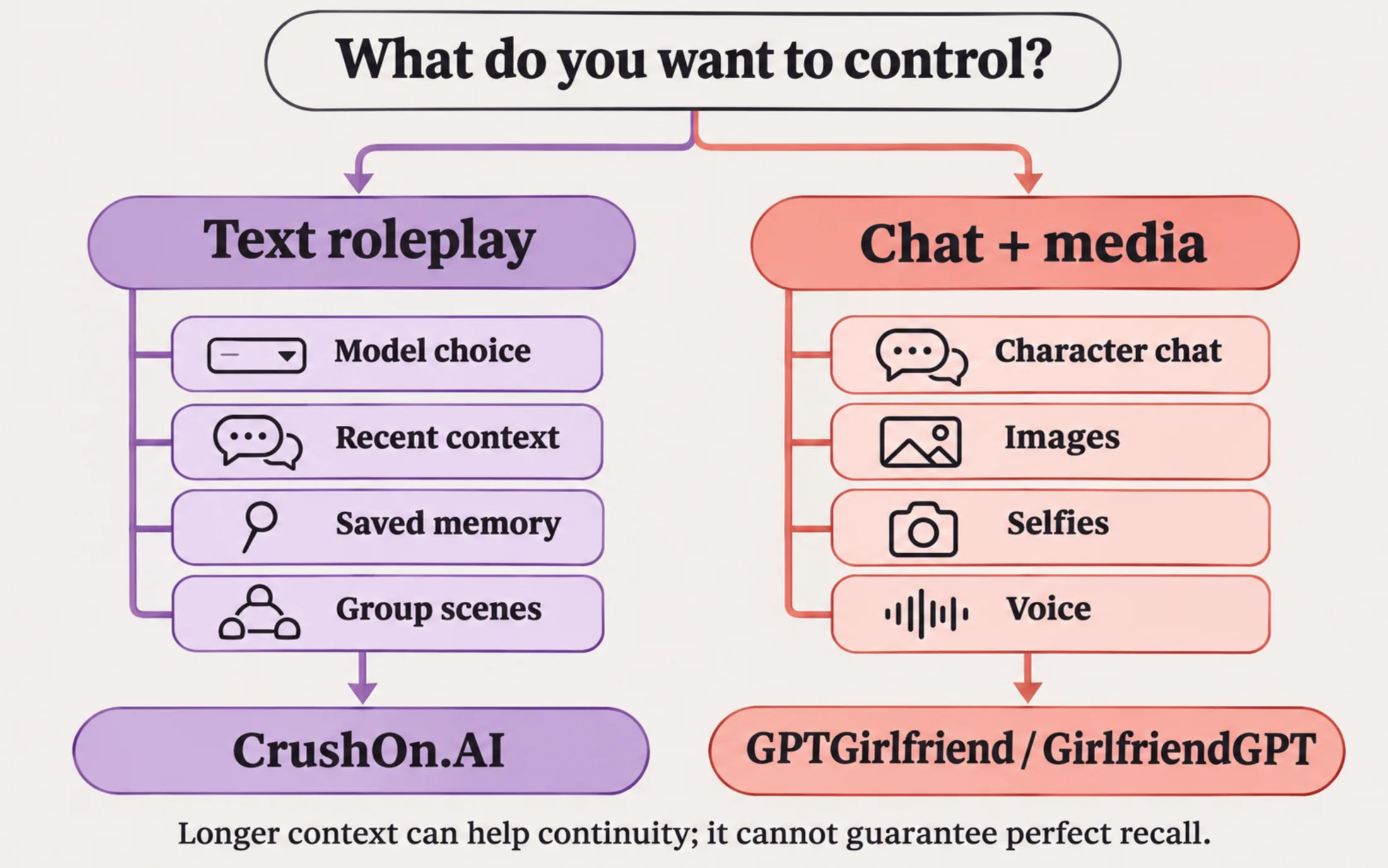
Choose the text-roleplay path for visible model and continuity controls, or the chat-plus-media path when images, selfies and voice are central to the interaction.
Images, selfies, visual roleplay, and voice
GirlfriendGPT has the clearer documented advantage when media is central to the interaction. Images and selfies can continue a scene visually, while voice adds another way to engage with the character. This combination reduces the need to move between a chatbot and a separate generator.
CrushOn.AI stands out more clearly for model choice, context management, text controls, and multi-character scenes. It documents voice options, but the available information does not establish that both services offer the same voice format, quota, responsiveness, or language coverage.
Ask specific questions when comparing media features:
- Is voice delivered as spoken messages, read-aloud output, or a live conversation?
- Does voice use the standard subscription allowance or separate credits?
- Can an image reflect the current scene, or must you restate everything in a prompt?
- Are selfies and standalone generations charged differently?
- Can appearance details remain consistent across several images?
- Are generated files retained after cancellation?
No supplied independent benchmark compares writing, image, or voice quality under equal conditions. Test the output type that matters most to you instead of judging it from a feature label.
Free access, subscriptions, and credits
CrushOn.AI currently presents its free-versus-paid structure relatively clearly. According to the official page, free models have no message cap, while Pro-model access includes a monthly credit allocation. Paid model choice, context settings, and other actions can affect consumption.
GirlfriendGPT’s official terms describe basic free access with limited messaging and a paid credit structure. Its current public pages do not show a stable, complete price table in every browsing state, so a third-party price list could create false precision. Sign in and inspect the current subscription screen.
Use this checkout checklist for either service:
- Is free messaging limited by message count, time, or model access?
- Which models or actions consume credits, and what rate does the interface display?
- Are images, selfies, and voice included or metered separately?
- Do unused credits roll over or reset?
- Does the available context change by tier or model?
- What is the renewal period, and is renewal automatic?
- How is cancellation completed, and what remains accessible afterward?
A low price means little if one plan mainly covers text while another bundles media. Estimate value based on the interactions you expect to use.
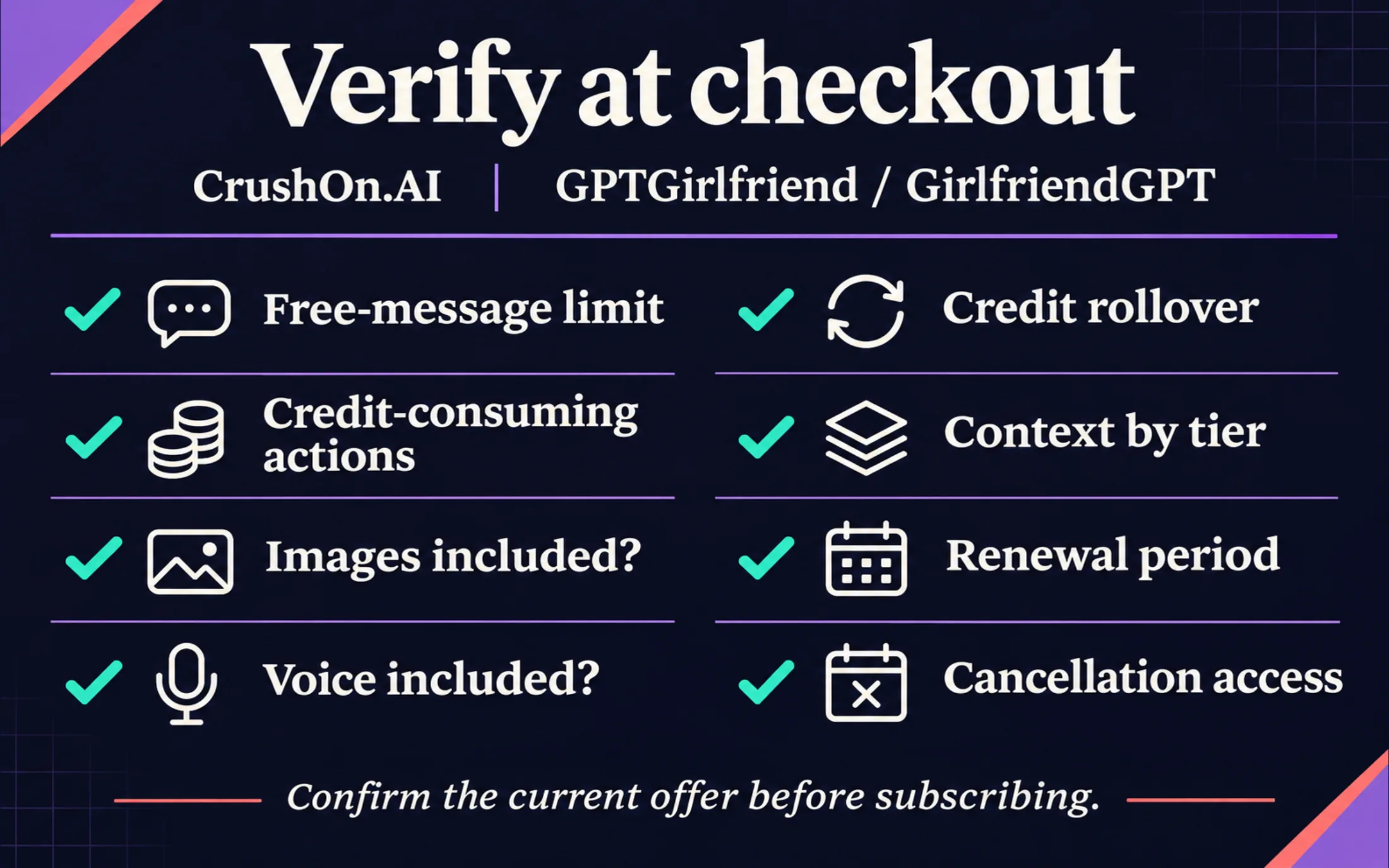
Verify the current allowances and subscription terms for either service instead of relying on an outdated price table.
Moderation: unfiltered does not mean rule-free
GirlfriendGPT promotes adult and unfiltered roleplay, while its community guidelines set boundaries. The service is for adults, restricts impersonation and non-consensual material, and describes both human and automated review.
CrushOn.AI also maintains platform rules and character-visibility controls. Its adult orientation does not permit every character, upload, or scenario. Check the current rules before publishing a public character, particularly when using a recognizable identity or uploaded material.
Moderation policies affect discovery, private and public creation, reporting, and whether a character remains available. Review the written rules and in-product visibility options instead of treating “unfiltered” as a complete policy description.
Mobile availability and continuity
CrushOn.AI documents continuity between web and mobile access. Its help material distinguishes iOS home-screen installation from Android APK availability, so mobile support does not imply identical native app-store distribution on every device.
GirlfriendGPT similarly documents a progressive web app and an Android APK. A PWA can behave like an installed app while remaining website-based; it is not necessarily equivalent to a conventional native store app.
On the device you plan to use, confirm that sign-in, history synchronization, character editing, media generation, voice, notifications, and subscription management work as expected. Regional availability and payment management can also vary by device or installation method.
Privacy questions to answer before uploading anything
Intimate conversations, character definitions, images, and voice inputs deserve careful review on both platforms. Before creating a character or uploading media, check:
- What chat content, saved memories, images, voice inputs, and account records are retained?
- Can individual conversations and generated media be deleted?
- What changes when a character is public rather than private?
- May uploaded or generated material be reused under the platform terms?
- How does full account deletion work, and what retention exceptions remain?
- Will purchased or generated media remain available after a plan ends?
- Which payment information is handled by the platform, and which is handled by its payment provider?
GirlfriendGPT publishes a privacy notice covering AI-companion discussions, collection and sharing categories, retention, and user rights. Read the current notice instead of assuming that deleting a visible chat immediately removes every related record.
Mimisy describes its own approach on its privacy and safety page, which provides a useful framework for evaluating private uploads and account controls. It is not an audit of CrushOn.AI or GirlfriendGPT.
Which platform should you choose?
Choose CrushOn.AI if you want to:
- Compare or switch AI models.
- Tune a text-first roleplay experience.
- Understand context and credit tradeoffs.
- Explore a particularly large community character library.
- Run scenes involving multiple characters.
Choose GPTGirlfriend/GirlfriendGPT if you want to:
- Combine adult character chat with generated images.
- Request selfies during an interaction.
- Make voice and visual roleplay central to the experience.
- Discover community characters in a media-connected ecosystem.
- Use one character workflow instead of assembling separate chat and image tools.
If prose style, character chemistry, image aesthetics, or voice quality will decide the choice, try both free experiences. Use a similar character premise and comparable prompts, but do not treat one reply as a scientific benchmark.
Start by choosing your preferred interaction style. Then inspect the relevant character ecosystem, test the available free access, compare the exact checkout allowances, and read the current moderation and privacy terms. Features, credits, and prices can change, so verify the live plan before subscribing.
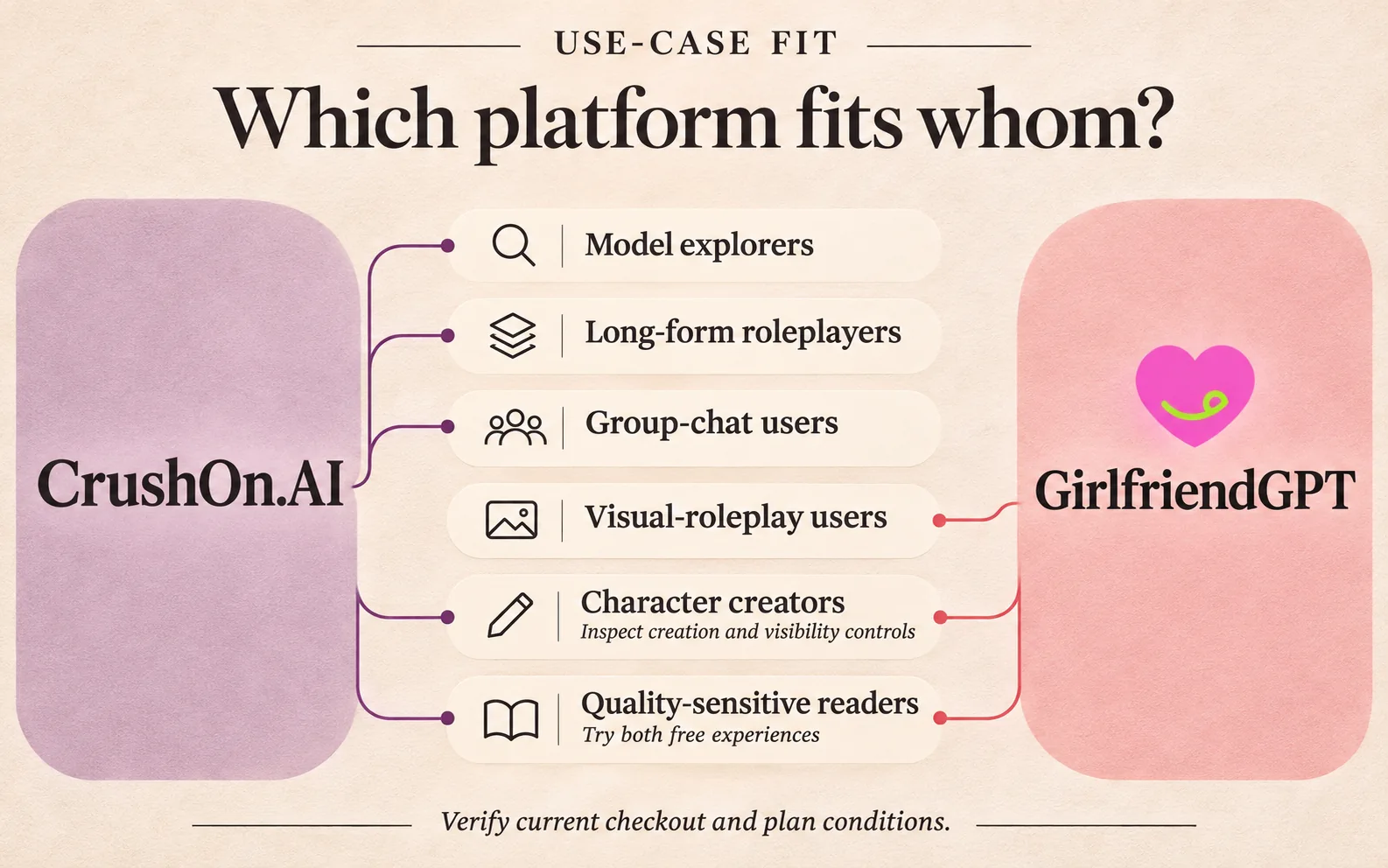
Choose by interaction style: CrushOn.AI emphasizes model and text-roleplay controls, while GirlfriendGPT emphasizes visual roleplay; creators and quality-sensitive readers should inspect or test both.
Find an effect for your next idea.
Browse the actual previews, choose your settings, and review the credit quote before you create.
Explore effects →