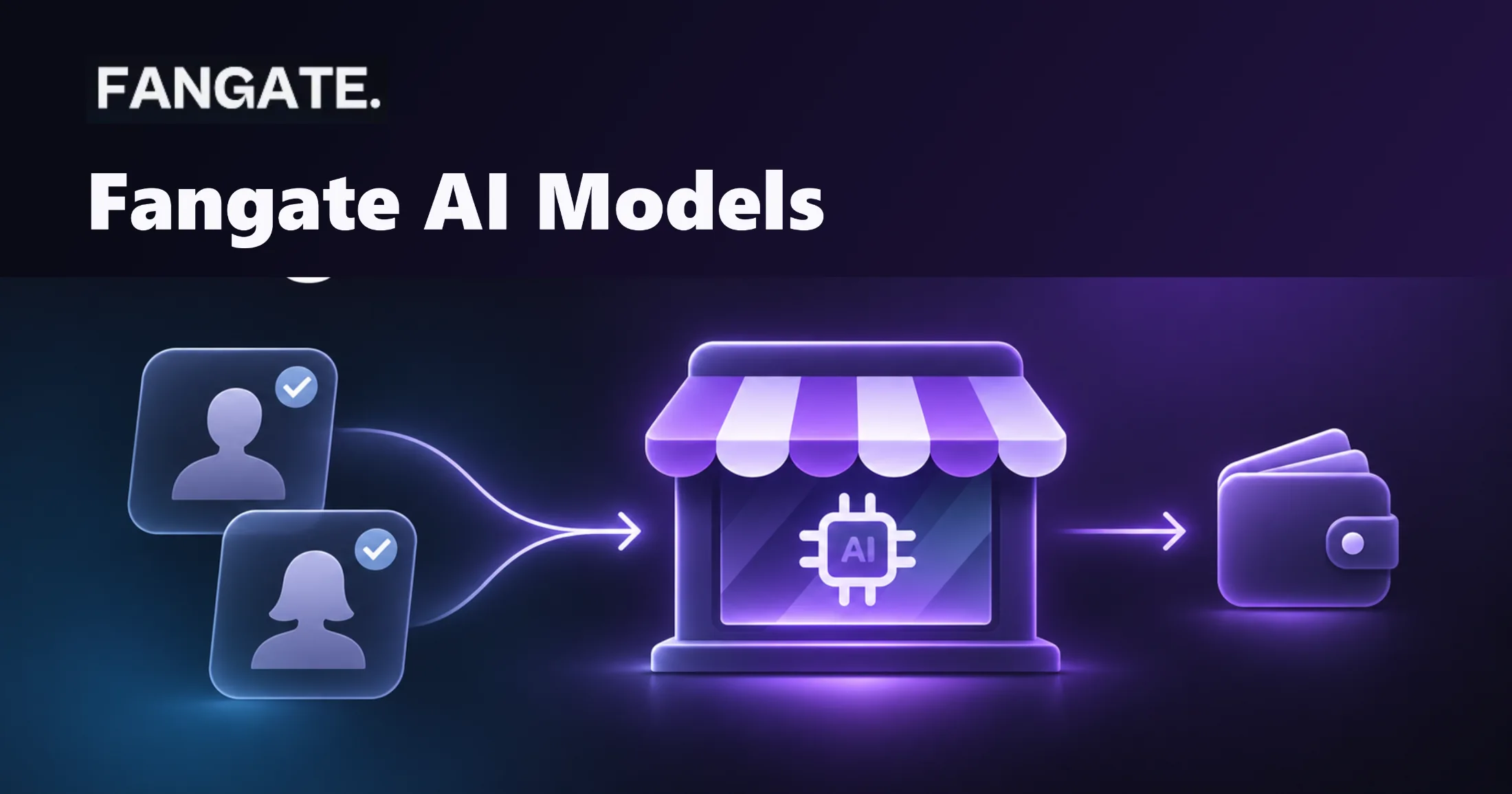
Fangate allows a verified agency or creator to create fictional AI model profiles within an existing account, upload products, sell them through a dedicated AI storefront, and receive the earnings in the controlling account’s wallet. Fangate outlined the system in its October 20, 2026 announcement, “Sell AI Content on Fangate: AI Models for Creators and Agencies.”
An AI model is not an independent account holder. According to Fangate, a verified human creator or agency creates and controls the model. Account access, verification responsibilities, and payments remain tied to that controlling account.
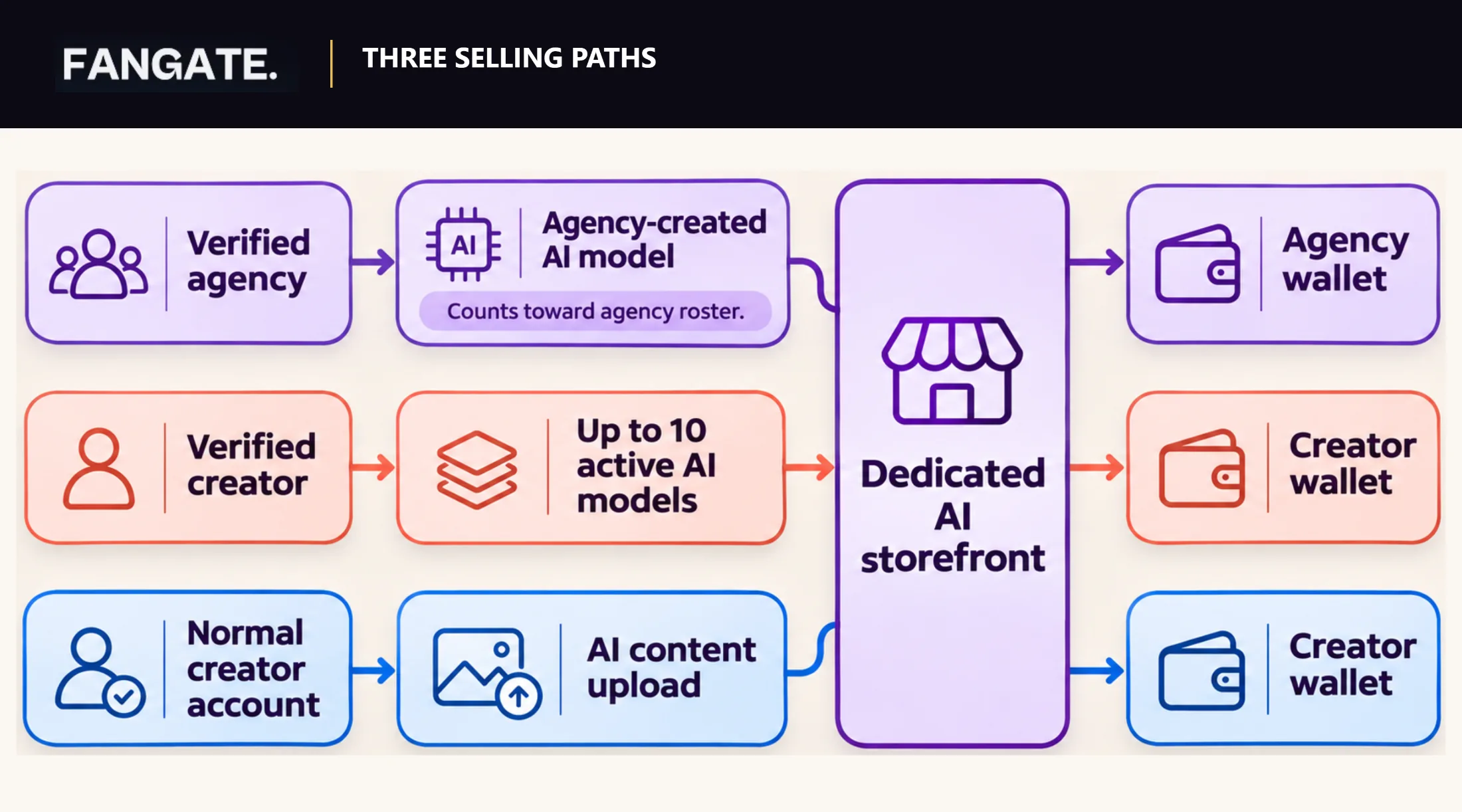
Fangate describes three ways to sell AI content: an agency can add fictional AI models to its roster, a verified creator can operate AI model profiles, or a creator can publish AI-generated or AI-modified products from a normal creator profile. The presentation and account ownership differ, even though the resulting products all enter Fangate’s AI-content system.
The three paths at a glance
| Selling path | Controller | Verification described by Fangate | Separate AI-model login? | Earnings destination | Stated limit |
|---|---|---|---|---|---|
| Agency-created AI model | Verified agency | Company review and ID verification for the agency representative | No | Agency wallet | Each model counts toward the agency roster |
| Creator-account AI model | Verified creator | Verification of the controlling creator | No | Creator’s Fangate wallet | Up to 10 active AI models |
| AI upload from a normal creator account | Verified creator account | Existing creator-account verification; additional consent workflow when another real person is the basis | Not applicable | Controlling creator’s account | No upload limit stated in the announcement |
This structure covers account control and merchandising. Fangate’s announcement does not identify the image, video, or text-generation technology creators must use, and it does not say that Fangate generates the personas itself.
Path 1: Agency-created AI models
Fangate says an agency must pass its company review and complete identity verification for its representative. Once accepted, the agency can select Add creator and then Create AI model.
The resulting profile is presented as an AI model but remains under the agency’s control. It does not receive independent login credentials or complete a separate identity-verification process. The verified agency and its representative supply the accountable account layer.
Each fictional model counts toward the agency’s roster. Agencies should therefore manage AI profiles as roster entries, not unrelated storefronts. The agency controls access, uploads, model positioning, and wallet ownership from its existing environment.
Fangate also says sales generated by these profiles are credited to the agency wallet. The announcement does not identify a model-level wallet, revenue-splitting feature, contractor payment system, or automatic allocation among staff. If an agency assigns designers or operators to a persona, its internal compensation arrangements remain separate from Fangate’s stated wallet flow.
Path 2: AI models inside a creator account
A verified creator can operate up to 10 active AI models, according to Fangate. The creator can switch between the personal account and fictional model profiles while staying inside the same controlling account.
Each model functions as an audience-facing identity rather than a new account owner. This arrangement may suit a creator who wants to separate fictional characters by style, theme, or audience without establishing an agency account for each one.
Fangate says all model earnings go to the verified creator’s Fangate wallet. It does not describe separate balances or payout credentials for individual personas. The announcement also leaves open which profile-level analytics or export options are available for comparing several characters.
The stated limit applies to active AI models. Fangate does not define whether archived or inactive models count, how quickly a slot becomes reusable, or whether other account restrictions affect the limit. Anyone planning a large persona portfolio should confirm those details in the current product documentation before building a publishing schedule around all 10 slots.
A fictional AI model also differs from a licensed digital representation of a known person. Mimisy’s explainer on OhChat creator personas and licensed AI twins covers a different arrangement centered on recognizable creator identities. Fangate describes its AI-model path as a system for fictional profiles controlled by an already verified creator or agency.
Path 3: AI content from a normal creator account
A creator does not need to establish a fictional model profile simply because a product contains AI content. Fangate says AI material can also be uploaded and sold from a normal creator account.
Fangate describes three classifications for these uploads:
AI generated: The content is completely fictional.
AI modified: The material is based on the uploader.
Based on another real person: The content uses another identifiable person as its basis, and Fangate says that person must provide consent through its workflow.
This route fits products for which the seller’s existing creator identity remains relevant. For example, someone transforming their own source material with AI could classify the upload as AI modified instead of creating a separate fictional persona.
Classification should reflect what the content depicts and how it was made. Under Fangate’s description, a wholly fictional subject and an AI-altered depiction of the uploader require different disclosures. Content based on another person adds a consent step.
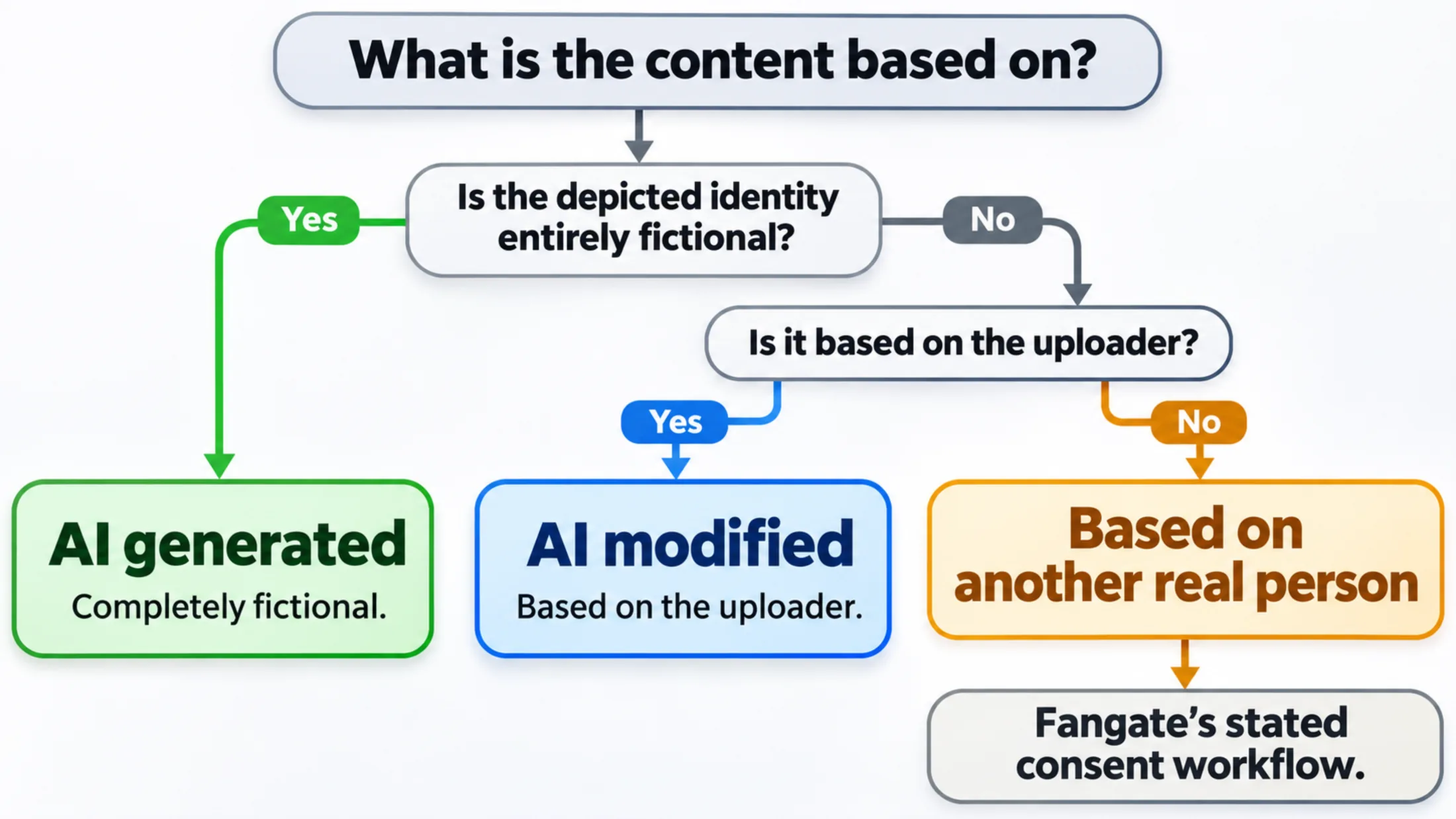
The content’s basis determines the Fangate label; content based on another real person proceeds to Fangate’s stated consent workflow.
Verification and model access
Fangate says fictional model profiles do not complete their own verification because they are not independent people or companies. Verification belongs to the human creator or agency representative who controls them.
The control chain works as follows:
- Fangate verifies the relevant creator or agency representative under its stated process.
- The verified account creates or manages the fictional profile.
- The controlling account switches into that profile to publish and manage products.
- Earnings return to the controlling account’s wallet.
Fangate’s published description does not give the model separate credentials at any stage. This clarifies who controls access, but it also makes the security of the controlling account especially important. The announcement does not specify staff roles, delegated permissions, recovery controls, or audit logs for agencies with multiple operators.
Account verification does not guarantee buyer demand or validate every claim attached to an uploaded file. Fangate describes a verification framework for accounts, but its announcement does not document an independent audit of every persona, source asset, consent record, or product description. Mimisy’s trust and responsible-use page provides a broader framework for assessing permission, private uploads, account control, and disclosure; it does not verify Fangate’s implementation.
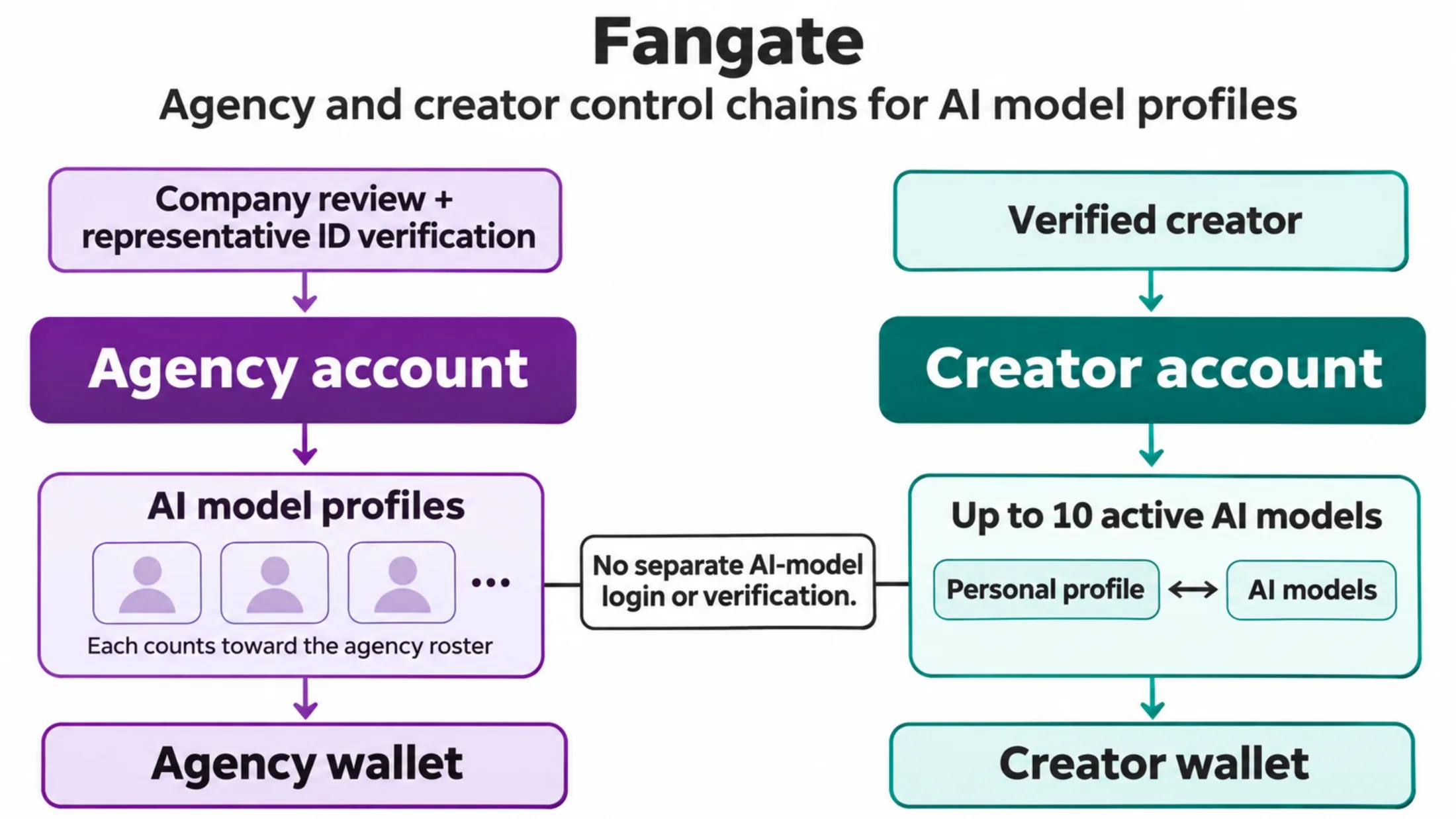
Verification and wallet ownership remain with the agency or creator account that controls each fictional AI model profile.
Consent when content is based on another real person
Fangate says content based on a real person other than the uploader requires that person’s consent through its workflow. This differs from the AI modified category, which Fangate describes as material based on the uploader.
A practical way to classify the content is:
- Decide whether the depicted identity is entirely fictional.
- If it is not fictional, determine whether it is based on the verified uploader.
- If it is based on somebody else, select the real-person category and complete Fangate’s stated consent process before publishing.
The announcement confirms that a consent workflow exists but does not explain what evidence Fangate collects, how it matches an identity, how long consent remains valid, or whether approval can be restricted to particular products. It also leaves questions about revocation, disputes, record retention, appeals, and products already purchased when consent is later withdrawn.
The visible classification and consent workflow disclose how a product was submitted; they do not, by themselves, establish the scope of any independent review. Sellers working with another person should inspect the current submission screens and terms rather than assuming the October announcement answers every permission question.
Why one AI file changes the entire product label
Fangate says that if one file in a product is AI content, the entire product is sold as AI content. A mixed bundle cannot be presented as wholly non-AI simply because most of its files were produced without AI.
For example, consider a product containing nine conventional photos and one AI-modified image. Under Fangate’s stated rule, the whole product receives the AI classification. A creator seeking different merchandising treatment could consider separating the files into different products, subject to Fangate’s current publishing rules.
The product-level rule gives buyers a consistent signal at checkout. It does not identify which individual files were generated or modified, what tool produced them, or the extent of the modification. Clear product copy can supply those details even when the platform applies a single label to the full bundle.
The dedicated AI storefront and visible labels
Fangate says labeled AI products appear in a separate AI storefront. Buyers can identify the category, while sellers gain a section intended for this material.
A label is not a technical provenance certificate. The announcement does not say Fangate can independently detect every generated file, reconstruct its production history, or verify the training data used by an external generation tool. It also does not establish that every consent submission receives an independent review.
Accurate labels still give buyers useful information and reduce ambiguity around mixed bundles. Before publishing, sellers should check every file in the product—not only the cover—so that an overlooked AI file does not result in an incorrect classification.
Checkout, wallets, and twice-monthly payouts
According to Fangate, buyers can pay for AI products using cards, Apple Pay, Google Pay, or cryptocurrency. These are buyer checkout methods. They are separate from the wallet that receives seller earnings and from the creator payout schedule.
Fangate says earnings enter the controlling agency or creator account’s wallet, with payouts running on the 1st and 15th. The announcement does not specify fees, supported currencies, minimum payout balances, processing times, exchange rates, refund handling, chargeback allocation, tax treatment, or the effect of weekends and holidays on the schedule.
Creators should check the current payment terms before forecasting cash flow. A scheduled payout date does not necessarily mean funds will reach an external bank or wallet that same day. Mimisy’s credits and payments guide explains the general distinction among a buyer-facing payment instrument, an internal balance, and an external payout. The guide covers Mimisy’s system rather than Fangate’s terms.
Monetization rules also vary between platforms. Mimisy’s Pornhub creator-program guide shows how eligibility, uploads, labeling, and revenue mechanisms can depend on the service involved. Fangate’s workflow must be assessed using Fangate’s own published terms.
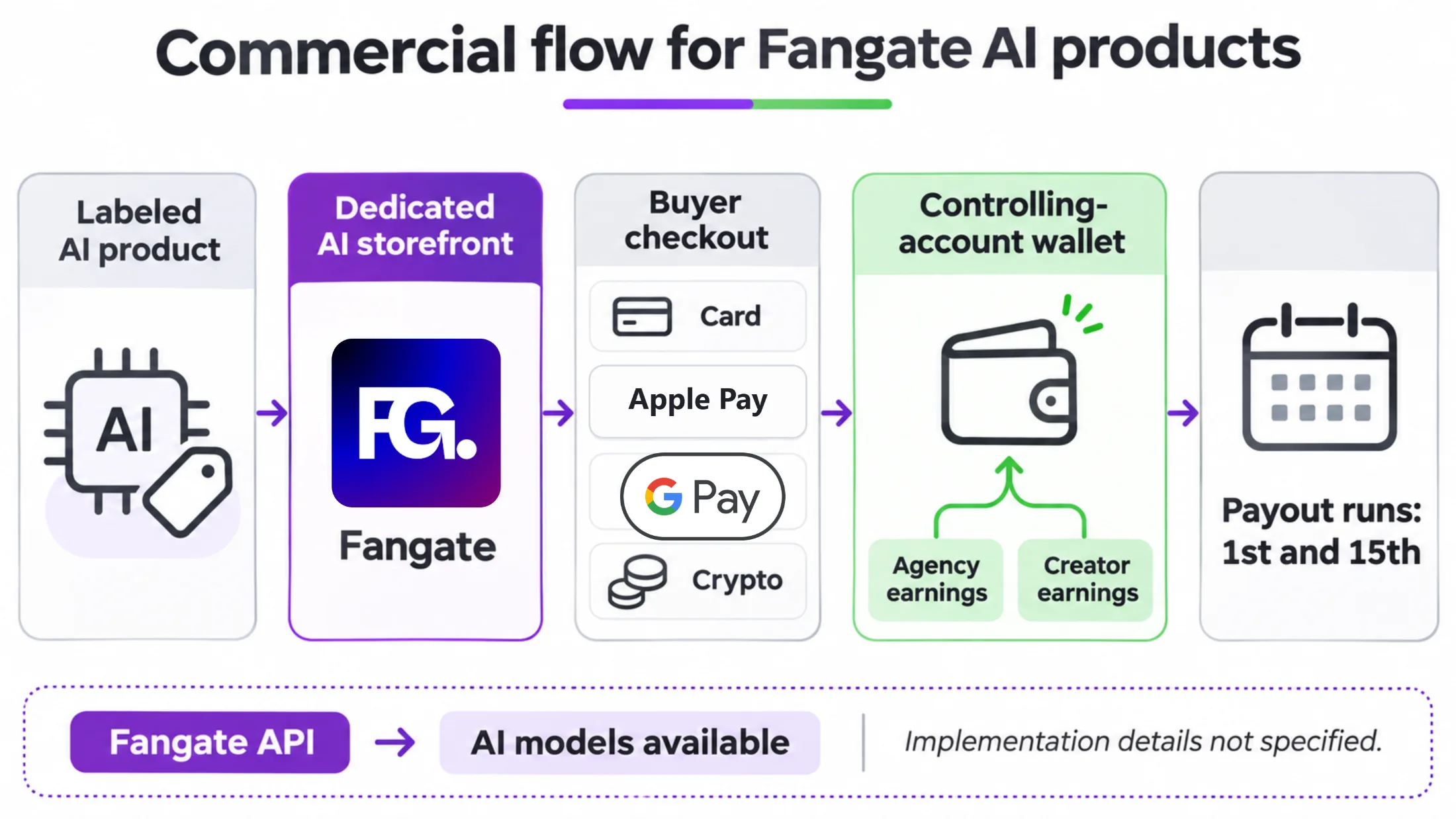
Buyer payment methods are distinct from the controlling account’s earnings wallet and Fangate’s stated payout schedule; API availability is shown separately because implementation details were not announced.
API availability and missing implementation details
Fangate says AI models are available through its API. This could be useful to agencies or creators managing repeated uploads, persona metadata, or internal publishing tools.
The October announcement does not provide endpoints, authentication methods, permissions, rate limits, supported actions, approval requirements, error behavior, or automation boundaries. It also does not say whether the API can create models, switch identities, submit consent records, upload products, retrieve wallet data, or initiate payouts.
The availability statement is not an integration specification. Developers need Fangate’s current API documentation to determine which actions their account type can perform and how those actions should be tested.
Questions the announcement leaves open
Fangate’s article defines the account and selling workflow, but it does not establish:
- which model-generation technologies sellers use;
- who owns or operates those generation tools;
- what training data underlies generated content;
- output quality, consistency, or production speed;
- buyer demand for particular fictional personas;
- sales performance or likely earnings;
- platform fees, payout thresholds, or settlement times;
- detailed moderation standards and enforcement procedures;
- how consent evidence is reviewed, audited, revoked, or disputed;
- independent verification of Fangate’s compliance processes;
- detailed API endpoints, permissions, limits, or integration requirements;
- guaranteed continuing availability of every announced feature.
The separate storefront, payment choices, profile limit, and payout schedule describe infrastructure attributed to Fangate. They do not show that a new model will attract customers or generate revenue.
A practical pre-publication checklist
Before launching an AI product or persona under Fangate’s announced system:
- Choose the correct path. Use an agency-created model, a creator-controlled fictional model, or a normal creator upload according to who should control the identity and wallet.
- Complete the applicable verification. Fangate says agencies require company review and representative ID verification, while creator models sit under a verified creator account.
- Identify the content basis. Decide whether it is completely fictional, based on the uploader, or based on another real person.
- Use the stated consent workflow when required. If the content is based on another real person, follow Fangate’s process and inspect its current requirements.
- Check every file in the product. Fangate says one AI file makes the entire product an AI product.
- Review the buyer-facing presentation. Confirm that the AI label and product description accurately explain what is being sold.
- Verify the current commercial terms. Recheck checkout methods, wallet rules, fees, thresholds, and the stated 1st-and-15th payout schedule.
- Read the API documentation before automating. Do not infer endpoint capabilities from the general statement that AI models are available through the API.
Fangate’s announcement describes an account-controlled system for selling labeled AI content. Verified creators or companies operate fictional profiles, products enter an AI storefront, and earnings return to the controlling wallet. Demand, revenue, generation quality, and independent enforcement remain separate questions for creators and agencies considering a virtual persona portfolio.
Find an effect for your next idea.
Browse the actual previews, choose your settings, and review the credit quote before you create.
Explore effects →