
The AI porn drama of 2026 grew out of several connected disputes: rapidly improving generative media, weak controls over how it is used, and mounting pressure on the systems that distribute and sell it.
Adult-capable image and video agents have spread beyond niche synthetic-character sites into mainstream AI products, companion services, creator storefronts and messaging operations. Meanwhile, real-person likeness abuse, sexualized-minor risks, inconsistent moderation, app-store distribution, age assurance, creator consent, disclosure, payments and platform rules have become increasingly difficult to address separately.
The main question is whether a product can establish who or what is depicted, show that every real participant authorized the use, restrict access appropriately and respond when its controls fail.
Three categories that must remain separate
Much of the debate becomes confused because the “AI porn” label covers very different kinds of content. A useful analysis starts with three categories.
Adult-only fictional content uses original, unambiguously adult characters that are not presented as identifiable real people. It can support fictional companions, entertainment products, virtual creator brands and licensed media businesses.
Authorized creator production uses a real adult’s appearance, voice or persona with documented permission. Examples include creator-approved digital twins, AI-assisted edits of a creator’s own material and messaging systems operating within an agreed persona. That authorization needs a defined scope. Permission to create one type of image does not automatically cover every medium, scenario or downstream product.
Abusive or prohibited content includes non-consensual intimate imagery involving an identifiable person and any sexualized-minor material. Its consent, age and harm characteristics are fundamentally different from those of authorized production.
Legitimate commercial activity belongs in the first two categories. Original fictional personas and licensed adult creator twins can be viable products, but they do not legitimize real-person deepfakes or material involving minors.
The dated 2026 timeline
Several developments during 2026 turned a long-running moderation dispute into a broader enforcement, product-governance and distribution issue.
| Date | Development | Why it mattered |
|---|---|---|
| May 20 | US DOJ announces TAKE IT DOWN Act arrests and charges | Connected sexual-deepfake publication to a major federal enforcement action |
| July 24 | EU Regulation 2026/1744 published | Made demonstrable consent safeguards an operational product issue |
| September | Australian eSafety guidance identifies higher-risk services | Applied a risk-based view to generators, nudify tools and interactive companions |
| September 30 | UK intimate-image-abuse factsheet updated | Described a tool-related offense and a maximum 48-hour removal period after reports |
| November 18 | US senators question app-store handling of a reported app network | Shifted attention toward concealed functionality, advertising routes and post-approval monitoring |
May 20: the first cited TAKE IT DOWN Act deepfake-porn arrests
On May 20, the US Department of Justice announced two arrests and charges described as the first of their kind under the TAKE IT DOWN Act’s deepfake-porn provisions.
Prosecutors alleged that the defendants published thousands of AI-generated deepfake images and videos appearing to depict real people. The announcement said one defendant had allegedly published at least 360 albums depicting approximately 90 female victims since May 19, 2025.
The announcement concerned allegations, arrests and charges, not convictions. The case was still significant because it showed how generation, organized publication and the number of alleged victims could be considered together in an enforcement action. Describing an output as “AI-generated” does not erase the identity of the person it represents.
July 24: the EU makes consent a demonstrable safeguard
Regulation (EU) 2026/1744 addresses AI systems intended to generate or manipulate identifiable intimate material. Its consent provisions point toward reliable collection and demonstration of the depicted person’s consent where applicable.
The practical requirement goes beyond adding a checkbox during registration. A defensible record should connect:
- the verified adult granting permission;
- the source assets covered by that permission;
- the permitted formats and uses;
- any distribution or commercial rights;
- the duration and revocation status of the authorization; and
- the generated or modified material produced under it.
A broad clause buried in general terms carries little weight when a service cannot show who authorized a particular use. Consent is becoming part of product infrastructure: a current record that generation, moderation, support and distribution systems can consult.
September: Australia identifies higher-risk adult AI services
The Australian eSafety Commissioner’s September 2026 regulatory guidance treats bespoke pornography generators, nudify models and interactive virtual-girlfriend services as potentially higher-risk services. It also recognizes that users may circumvent safeguards in general-purpose tools.
This is regulatory guidance, not a criminal judgment against every product in those categories or a blanket ban on adult AI. Its significance lies in its risk-based approach. A service designed specifically for intimate generation is likely to face different expectations from a general image editor. Calling a product general-purpose may offer little protection when its controls are easily bypassed.
This approach encourages safeguards at account access, source-media submission, real-person authorization, generation and distribution. It also puts pressure on companion products to distinguish fictional adult personas from interactions or media based on real people.
September 30: the UK targets tools and response times
The UK Home Office’s September 30 intimate-image-abuse factsheet describes a new offense involving making, supplying or offering a thing intended for use as a purported intimate-image generator.
The factsheet also describes duties for covered platforms following a valid report of non-consensual intimate imagery. Reported material must be removed as soon as reasonably practicable and no later than 48 hours. A prohibition in the terms of service is therefore insufficient on its own. A platform also needs an accessible reporting route, a process for evaluating reports, a response clock and measures to address substantially identical material when it reappears.
Mimisy’s article on the UK strangulation-porn provisions covers a different part of the Crime and Policing Act 2026. The two subjects are distinct, although both show UK rules becoming more specific about content categories and platform responsibilities.
November 18: app-store review enters the controversy
A November 18 letter from US senators to Google cited AI Forensics reporting about a network of 444 connected applications. According to the reporting summarized in the letter, some apps allegedly concealed sexual-deepfake functionality during store review and revealed it through advertising or referral paths.
The letter raised questions; it did not establish guilt for every listed app, and Mimisy has not independently verified each application. Even so, the reported network exposed the weakness of treating initial app approval as the end of platform governance.
Store operators may increasingly need to examine post-approval behavior, advertising destinations, shared infrastructure, connected developer accounts and differences between the version shown to reviewers and the experience users eventually reach. Distribution oversight is becoming a continuous process.
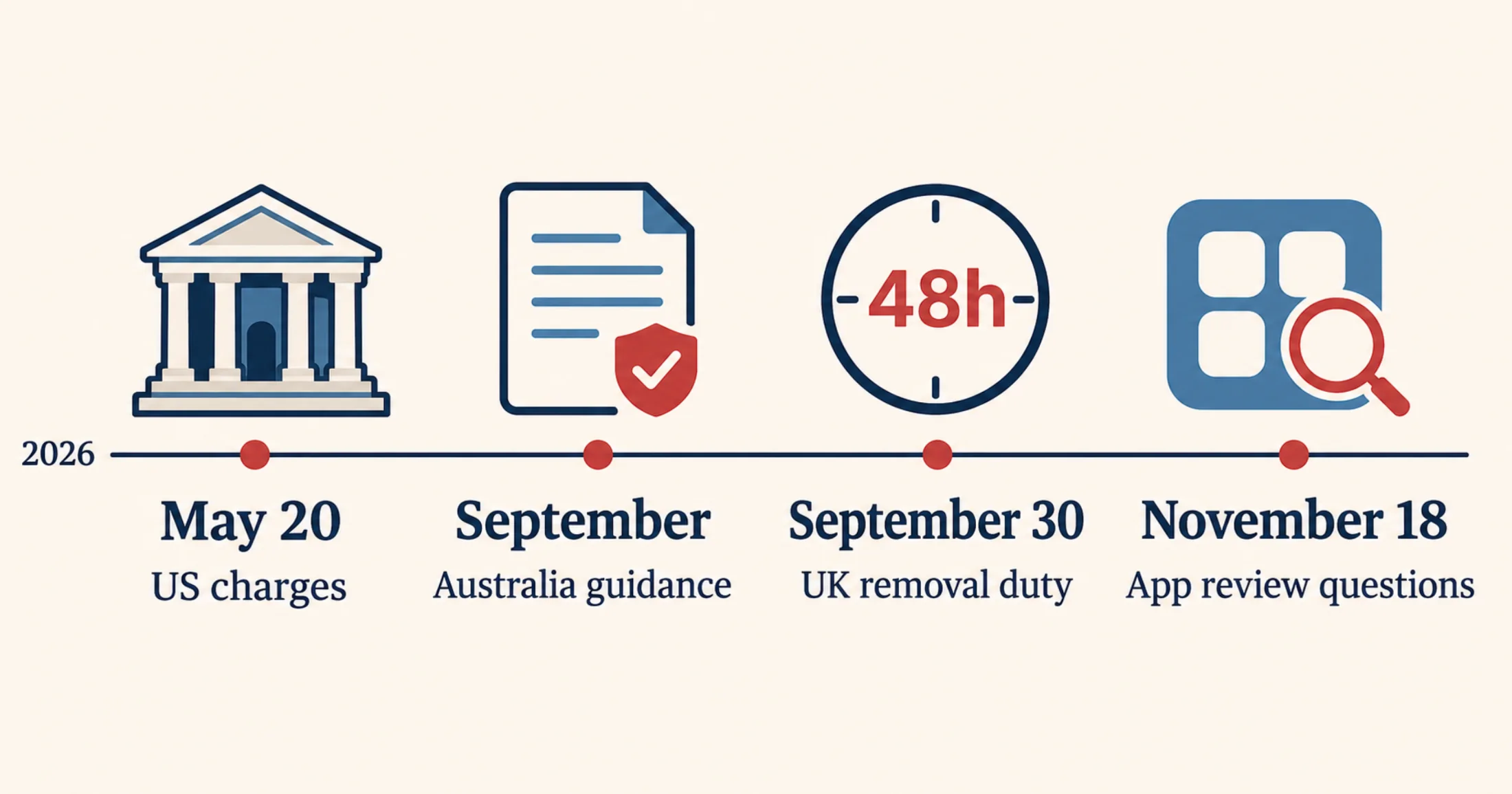
Four key 2026 milestones show the dispute expanding from enforcement into regulatory guidance, removal duties and app-store oversight.
Why 2026 was a market shift
Generative adult media once appeared to be a specialist category dominated by synthetic-character sites. By 2026, related capabilities could be found across mainstream agents, image and video tools, companion services, creator storefronts and fan-messaging systems.
This expansion also exposed the limits of saying that “the model allows it.” Public policy, underlying model behavior, product-level moderation and one user’s result are separate layers. Mimisy’s dated AI-agent field test illustrates how behavior can vary by model, interface, account, configuration and date. One successful or refused request does not establish how every surface from the same company will behave.
The inconsistency creates commercial problems alongside moderation failures. Creators cannot build dependable workflows around capabilities that may disappear without warning. Platforms cannot rely entirely on model-provider filters. Users also cannot assume that a technically possible output is permitted under the tool’s rules.
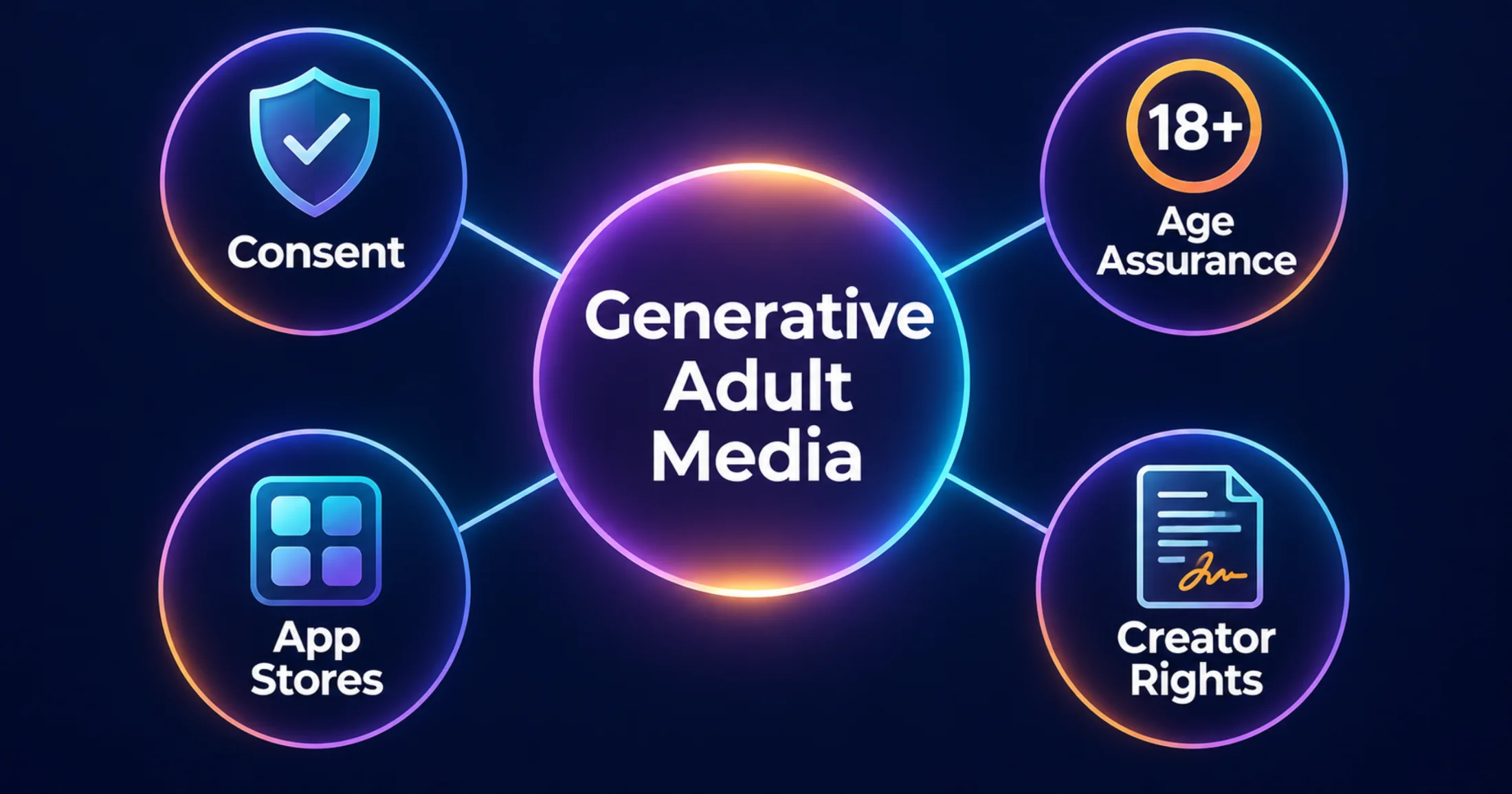
The 2026 market shift brought generative adult media into collision with consent, age assurance, app-store distribution and creator rights.
Where legitimate adult AI businesses still fit
Adult AI businesses do not have to choose between unrestricted generation and abandoning the category. Several legitimate models remain possible when they begin with fictional adults or documented creator authorization.
Creator-authorized digital twins
A participating creator can license defined uses of their likeness, voice or persona. Products such as the licensed twins discussed in Mimisy’s OhChat Pornstar Mode explainer demonstrate the basic boundary: access to an authorized digital twin does not transfer ownership of the creator’s identity or permit unlimited reuse.
A credible agreement should cover media formats, allowed scenarios, territories, term length, revocation, retained assets, revenue attribution and whether the license can be transferred. The product also needs a way to stop future generation when authorization expires or is withdrawn.
Fan-DM assistance with human escalation
AI can greet fans, handle routine conversations and help operators prioritize an inbox. It cannot be assumed to know facts the creator never supplied or exercise sound judgment in every commercial or sensitive exchange.
As Mimisy’s Mimic AI analysis explains, payment intent, custom requests, disputed facts, sensitive conversations, identity uncertainty and technical problems are natural handoff points. A visible route to a human operator is part of quality control.
Labeled storefronts and original fictional personas
AI storefronts can sell products built around clearly labeled fictional adults. The Fangate AI Models explainer gives one example of verified controlling accounts operating fictional AI profiles and selling labeled products.
Original personas can also support subscription, licensing, companion or media businesses. Generation alone does not make a durable commercial plan. Mimisy’s AI monetization guide covers the surrounding work: building a consistent identity, producing selectively, choosing suitable distribution, developing paid offers, retaining customers and maintaining workable unit economics.
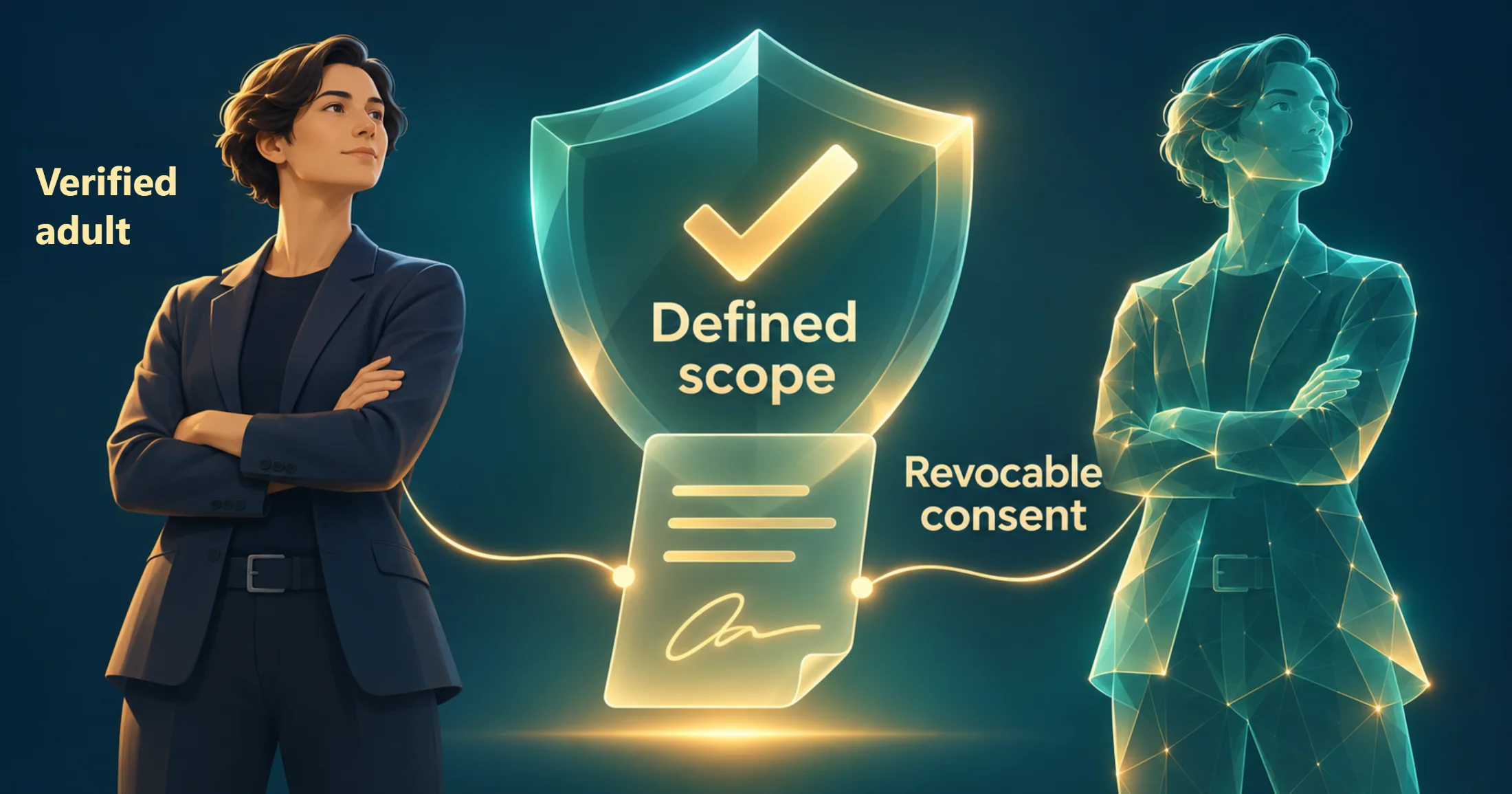
A legitimate creator digital twin depends on verified adulthood, a defined authorization scope and consent that can be withdrawn.
The operating controls that now matter
Authorized products need systems that make important decisions reviewable.
- Identity and age verification: Confirm that every real participant is an adult and that the authorizing identity matches the person represented.
- Scoped authorization: Record permitted source assets, formats, scenarios, distribution channels, commercial uses and duration.
- Revocation handling: Define what happens to future generation, stored models, published outputs and downstream licenses when permission ends.
- Disclosure: Tell users when a persona, image, voice or conversation is synthetic or materially AI-modified.
- Provenance: Preserve generation records, authorization references, labels and relevant metadata so claims can be demonstrated to platforms or commercial partners.
- Access and output controls: Apply restrictions when users upload source media, request real-person transformations or export results, as well as at account entry.
- Human review and escalation: Route uncertain identity, sensitive conversation, custom-request, payment and complaint cases to an accountable person.
- Quality control: Check for identity drift, unintended resemblance, inconsistent character age, misleading labels and outputs beyond the authorized scope.
Readers evaluating a service should compare these controls with its public claims, privacy practices, deletion options and commercial relationships. Mimisy’s Trust page explains the permission and product-evaluation principles used on the site.
Capability does not equal platform fit
The ability to generate an output does not guarantee that an app store, creator platform, payment provider or advertising network will accept it. Each system makes its own decisions about account eligibility, uploads, labeling, payments, discoverability and revenue programs.
A single platform may also apply different rules to hosting and monetization. Mimisy’s explanation of Pornhub SFW rules, uploads and creator revenue shows why content classification, upload acceptance and program eligibility need to be checked independently.
A practical launch review should answer four questions:
- Can the chosen tool create the intended material under its current rules?
- Can that material be uploaded to the selected destination?
- Will the payment and advertising partners support the business model?
- Does the account qualify for the relevant creator or revenue program?
Approval at one layer does not settle the other three.
Five likely directions after 2026
These are reasoned outlooks rather than guarantees. Jurisdictions and platforms may move at different speeds.
1. Verified consent will become a workflow
More products are likely to connect identity, age, permission scope, source assets and revocation status. Generation involving a verified creator may require an active authorization record, while unsupported real-person uploads receive stricter treatment.
2. Provenance and disclosure will become more visible
Synthetic-media labels, metadata, generation histories and platform-facing authorization evidence are likely to become more common. No single marker can resolve every dispute, but combined records can make content easier to assess and complaints easier to investigate.
3. Age assurance will move deeper into products
Landing-page confirmation is unlikely to remain the only control. Services may add checks at account access, source-media submission, real-person authorization and generation layers, especially around higher-risk features.
4. Product ecosystems will segment more sharply
General-purpose agents, adult-only fictional platforms, verified creator tools and restricted real-person-likeness services have different risk profiles. More products may stop trying to serve all four markets through one interface and one set of rules.
5. Licensing may outperform unlicensed likeness reuse
Creator licensing and revenue sharing give platforms, distributors and payment partners a clearer basis for supporting a product. They do not guarantee commercial success, but documented authorization is operationally easier to defend than anonymous or unlicensed reuse.
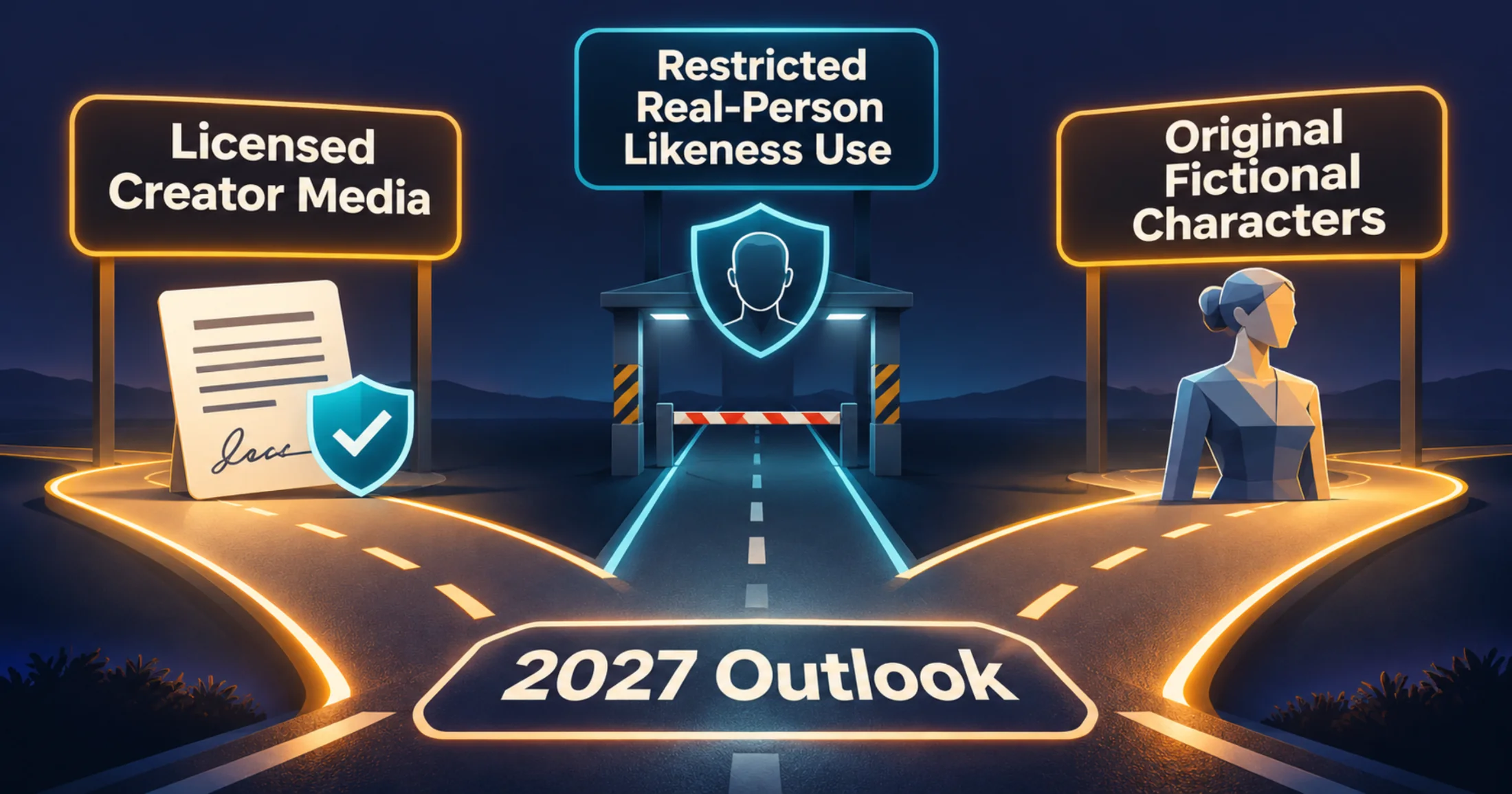
What to watch in 2027
Users should look for clear synthetic-media labels, meaningful age controls, understandable privacy terms, accessible deletion and reporting routes, and an explicit distinction between fictional creation and real-person likeness use. A service that promises permissive generation but says little about consent or reporting warrants closer inspection.
Creators should examine license scope, term, revocation procedures, treatment of trained assets, disclosure language, revenue attribution and compatibility with intended distribution channels. Human control remains important for sensitive messages, custom work, payment disputes and claims made in a creator’s name.
Tool builders should monitor jurisdiction-specific definitions instead of expecting one global rulebook. Key operational questions include app-store review expectations, report intake, response deadlines, recurrence prevention, age assurance, provenance, authorization audit trails and escalation ownership. Teams also need to test whether their controls still work after product updates, model changes and the introduction of new referral or export paths.
Generative adult media is likely to persist in a more segmented market. Adult-only fictional creation and explicitly authorized creator production have a clearer path than unlicensed real-person imitation.
Generation capability advanced ahead of distribution and accountability systems. In 2027, the more commercially defensible products will be those that can demonstrate consent, preserve provenance, disclose synthetic participation, control access and meet the requirements of the platforms through which they reach customers.
Find an effect for your next idea.
Browse the actual previews, choose your settings, and review the credit quote before you create.
Explore effects →