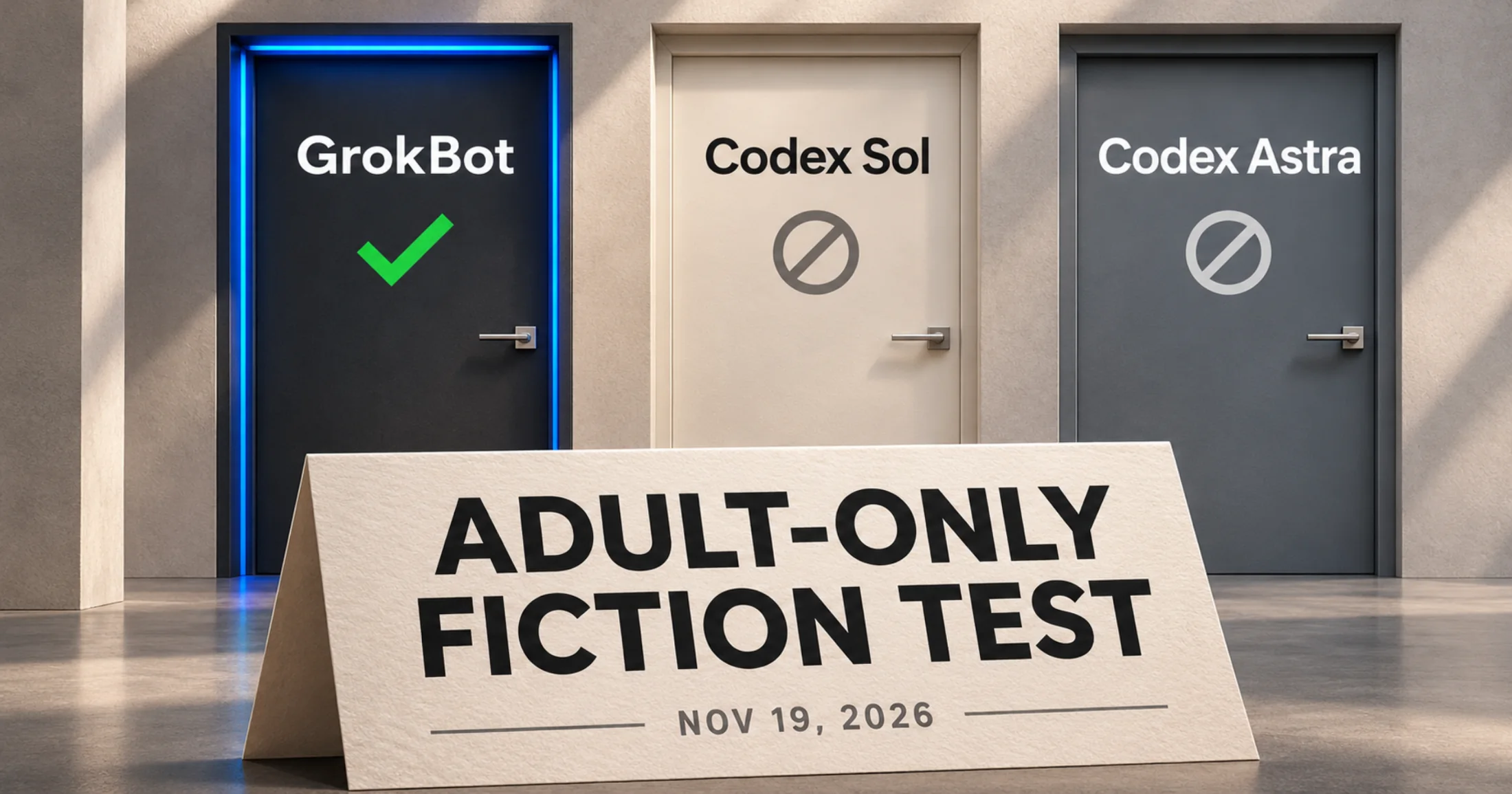
Here is the direct, dated answer: in my hands-on tests on November 19, 2026, GrokBot generated adult-only fictional NSFW content. Codex GPT-6.2 Sol and GPT-6.2 Astra refused the same general class of requests, making both ineffective for this specific task. That conclusion says nothing about their value for coding, research, editing, or other work.
GrokBot’s response followed a recent change in behavior or policy enforcement. One test cannot reveal whether the underlying model changed, a moderation rule changed, or the product began applying an existing rule differently.
The result does not promise that GrokBot will answer every adult request, nor does it show that every Grok surface permits the same material. Results can vary with the product surface, mode, account, region, prompt wording, age-gating status, configuration, and moderation system active at the time.
The test used a clear boundary: no minors. Every scenario involved explicitly identified fictional adults. I excluded ambiguous ages, coercion, real identifiable people, and requests to reproduce anyone’s likeness.
What my conclusion covers
My finding answers a narrow, practical question: when I submitted comparable adult-only fictional-content requests through the tested surfaces on November 19, which agents generated material and which refused?
GrokBot generated it. Codex GPT-6.2 Sol and GPT-6.2 Astra did not.
This does not establish that GrokBot has an official, permanent “NSFW enabled” feature. A refusal also does not prove that Sol or Astra lack the technical ability to produce the requested prose. The model may be able to form an answer while a product-level control prevents that answer from reaching the user.
“Which AI allows NSFW content?” sounds like a simple feature question, but several systems shape the answer. An acceptable-use policy may define an outer boundary, the model may have default response tendencies, and a particular product may apply stricter filters. Users can still receive different results across sessions.
The four layers people often confuse
| Layer | What it tells you | What it cannot establish by itself |
|---|---|---|
| Public policy | The provider’s published boundaries and prohibited uses | Whether a particular request will be generated on every surface |
| Model default behavior | How the underlying model tends to answer without additional product controls | What an app, bot, API deployment, or account will actually allow |
| Product-level moderation | Rules and settings applied to a specific interface or deployment | Whether another product using a related model behaves identically |
| Actual user result | What one user received in a dated, recorded context | A permanent capability guarantee for all users, prompts, regions, or future sessions |
A public policy is not a feature list. Material that falls within a published boundary may still be unavailable in a particular interface. Likewise, a refusal does not necessarily mean that the public policy prohibits the entire category.
The actual response is often the most useful information for someone choosing a tool today, but it can change quickly. For that reason, I record the date, surface, model, request class, and relevant settings instead of giving a provider a timeless “allows NSFW” label.
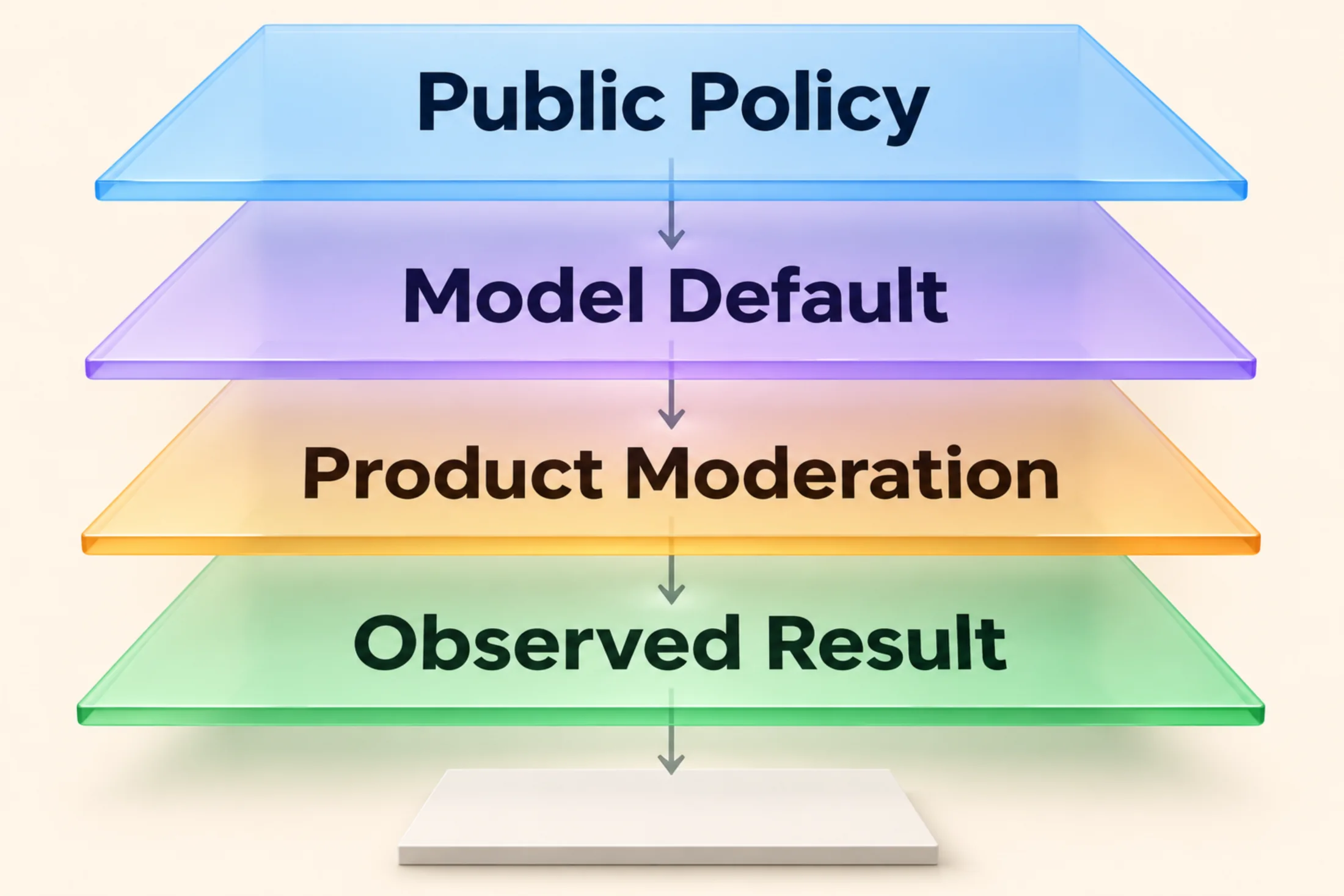
Policy, model tendencies, product controls, and a recorded result are distinct layers; none alone guarantees every future response.
My November 19, 2026 results
I used equivalent, non-jailbreak requests describing fictional scenarios with unambiguously adult characters. I have not reproduced the explicit prompts because readers can evaluate the products without copying sexual material or testing ways around safeguards.
| Surface or model | Test date | Request class | Observed result | Scope note |
|---|---|---|---|---|
| GrokBot | November 19, 2026 | Adult-only fictional NSFW generation | Generated | Personal result on this bot surface; current or future behavior may differ |
| Codex GPT-6.2 Sol | November 19, 2026 | Same general request class | Refused | Ineffective for this NSFW task; not a judgment of its coding or general abilities |
| Codex GPT-6.2 Astra | November 19, 2026 | Same general request class | Refused | Ineffective for this NSFW task; not a judgment of its coding or general abilities |
| Grok chat | Not established by this test | Not independently evaluated | No result assigned | A separate conversational surface; do not infer GrokBot’s result |
| Grok Imagine | Not established by this test | Image generation not independently evaluated | No result assigned | Must be tested separately from text generation |
GrokBot was the only successful adult-fiction generator among the three agents I tested that day. The results do not show that all Grok products allow NSFW content or that Codex can never generate adult material.
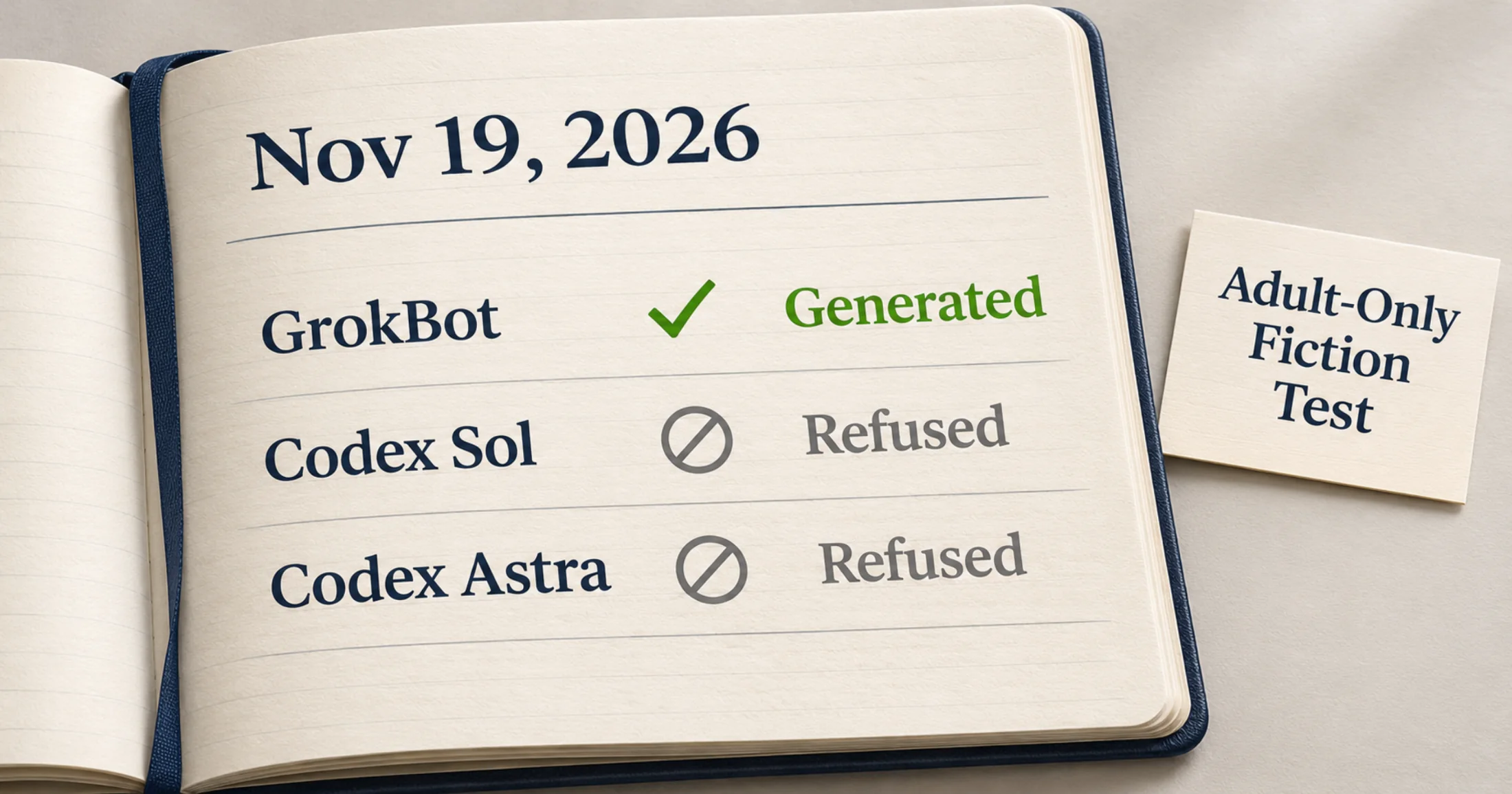
A visual record of the author’s November 19, 2026 test results; it represents that dated test rather than a permanent capability guarantee.
Grok chat, GrokBot, and Grok Imagine are different surfaces
Related product names do not make the services interchangeable.
Grok chat is the conversational product. Its modes, account controls, regional access rules, and active moderation may differ from those of another Grok deployment.
GrokBot is the bot surface used for this field report. The successful result belongs to that context. A different account, region, mode, prompt, or later moderation update could lead to a partial answer, redirection, or refusal.
Grok Imagine is an image-generation surface. Acceptance of adult fictional prose by a text bot does not establish what an image generator will create. Image systems may apply separate filters to nudity, real-person likenesses, age ambiguity, uploads, editing, and generated outputs. I did not independently test Grok Imagine, so I cannot transfer GrokBot’s result to it.
Codex is also a distinct environment. My Sol and Astra results describe how the named models responded in the tested Codex context, not every OpenAI product or API configuration.
A surface-by-surface comparison also helps distinguish general agents from purpose-built products. Someone mainly interested in character conversation may find the workflow differences in Mimisy versus SpicyChat more relevant than a general model comparison. Readers choosing between selectable text-roleplay controls and integrated media can use CrushOn.AI versus GPTGirlfriend to narrow the category first.
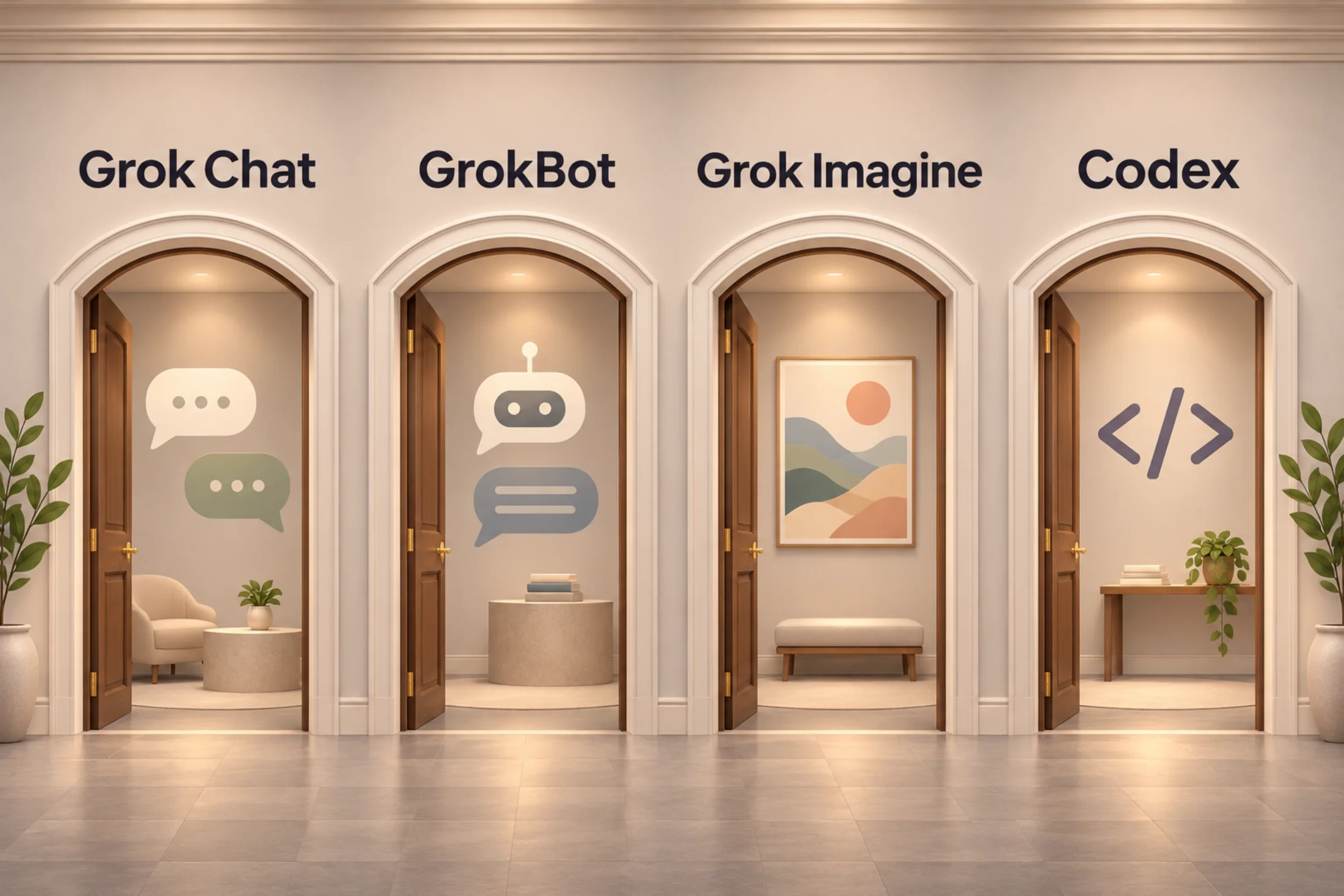
Each product surface is a distinct environment, so behavior observed in one should not be assumed for another.
What SpaceXSI’s public documentation says
SpaceXSI’s published documents show why “Grok allows it” is too broad a claim.
Its Acceptable Use Policy, effective August 14, 2026 in the supplied material, sets boundaries without guaranteeing a feature. Those boundaries prohibit sexualized minors and intimate or pornographic depictions of real identifiable people without consent. They also prohibit undressing or nudifying real people and altering a real person’s likeness into an intimate or sexual context.
The consumer terms, current as of October 27, 2026 in the supplied material, explain that selected features may produce suggestive dialogue or sexual situations. They also indicate that adult access can be age-gated by region. The phrase “selected features” matters because it does not promise identical access across every product surface, account, or region.
For developers, the custom moderation controls documentation, updated October 27, 2026 in the supplied material, says an API caller can add an nsfw=decline guideline. Categories that are not added retain default moderation behavior. Developers can therefore make one deployment more restrictive than another deployment using related technology. The documentation does not establish that every configuration permits NSFW content by default or predict how the consumer bot will answer.
SpaceXSI also provides reporting guidance for non-consensual intimate content, including AI-generated material involving identifiable individuals. That category is separate from fictional adult content. Permission to explore a fictional scenario does not extend to placing a real person into it.
OpenAI policy and my Codex refusals are separate evidence
The same four-layer distinction applies to OpenAI.
The supplied OpenAI Usage Policies page displays an effective date of November 20, 2026, one day after my November 19 tests. It prohibits sexual violence, non-consensual intimate content, non-consensual use of a person’s likeness, and any sexualization of anyone under 18.
That page cannot be used retroactively to prove why Sol and Astra refused on November 19. A published policy can describe boundaries without revealing the exact rule, classifier, product instruction, or model behavior behind an individual refusal. It also cannot predict every response across all OpenAI products.
My Codex conclusion comes from the responses I received: both GPT-6.2 Sol and GPT-6.2 Astra refused comparable requests involving fictional adults. Neither was useful for my adult-content-generation goal on that date. This finding does not suggest that either model is bad at coding, weak at general work, or unable to produce good prose in permitted contexts.
How to repeat this test without testing bypasses
A useful comparison needs consistent inputs and good records, not jailbreak instructions or elaborate adversarial prompts.
- Define an entirely fictional scenario and state clearly that every character is an adult aged 18 or older. Avoid ambiguous labels such as “young-looking” or settings that create uncertainty about age.
- Exclude coercion, sexual violence, minors, real identifiable people, celebrity likenesses, and requests to alter an uploaded person into an intimate context.
- Prepare a small set of equivalent neutral requests. Keep the requested format, level of detail, fictional premise, and adult-age statement consistent across products. Do not add product-specific bypass language.
- Use ordinary settings. Do not disable safeguards, disguise the request, or try to make the model ignore its controls.
- Record the provider, exact product surface, model, mode, date, account region, age-gating state, relevant settings, and whether files or images were supplied.
- Classify each response as generated, partially answered, redirected, or refused. Save the response wording when the product permits it.
- Repeat the comparison with a few similarly bounded adult-fiction scenarios. Record variability rather than selecting only the most permissive response.
This method gives you a dated, reproducible result for a specific workflow. If behavior changes, keep the older observation and add a new dated entry instead of rewriting the earlier record.
Which option fits each goal?
| Your goal | Best practical direction | Why |
|---|---|---|
| Adult-only fictional text from the tested agents | Recheck GrokBot first | It was the only successful option in my November 19 test, but current behavior still needs verification |
| Adult fictional generation in Codex | Do not choose Sol or Astra based on this test | Both refused and were ineffective for this specific task; this says nothing about their coding value |
| Adult image generation | Evaluate Grok Imagine independently | A GrokBot text result does not establish image-generation behavior |
| Detailed character roleplay | Compare purpose-built companion services | Their character, memory, roleplay, and media workflows may fit better than a mainstream agent |
| Visual companion creation | Compare visual-first products and their current controls | Mimisy versus Fapify explains relevant workflow differences |
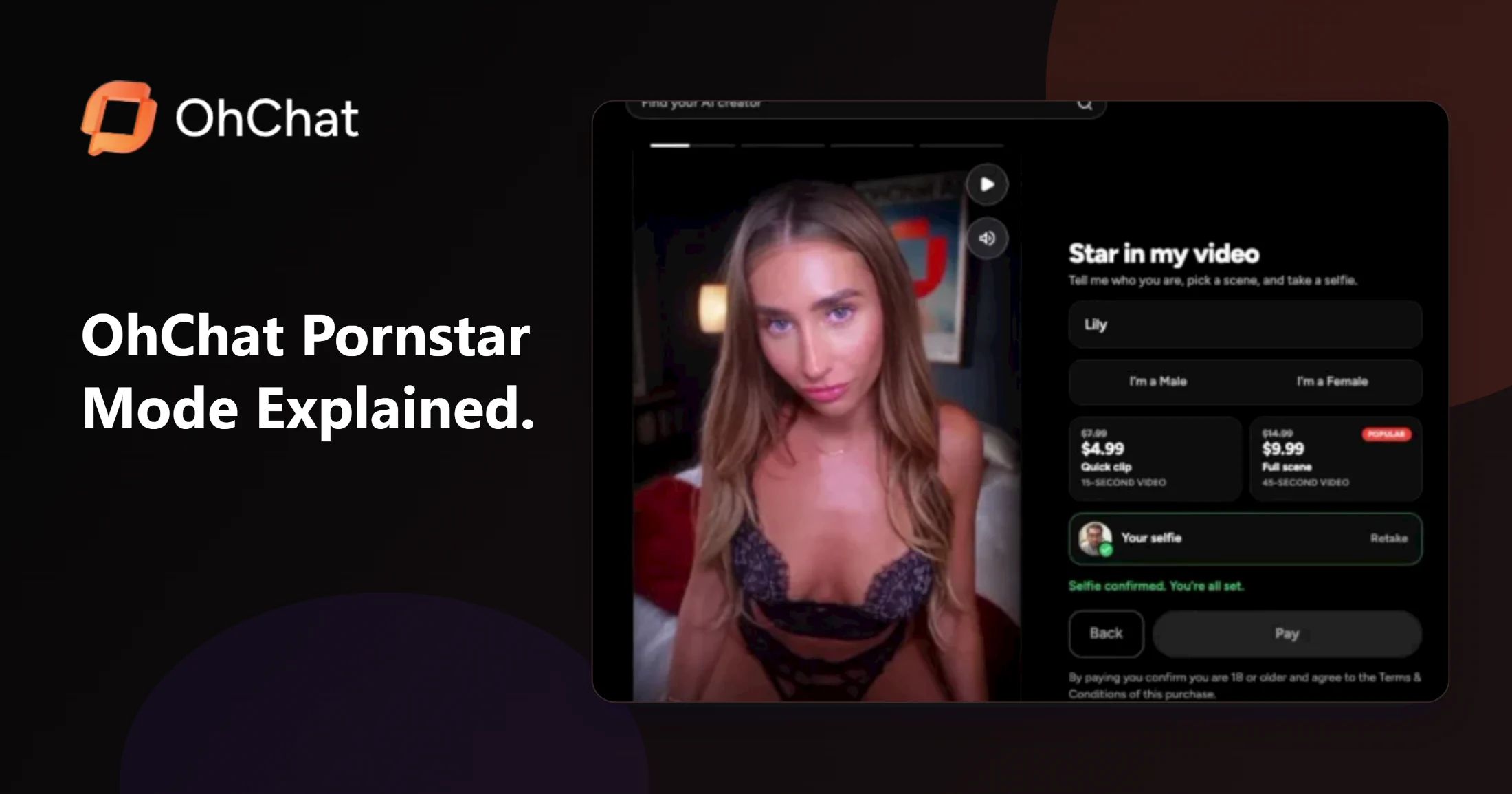
| Persona-based interaction connected to an authorized creator | Examine the product’s identity model | OhChat’s Pornstar Mode illustrates how a licensed persona differs from a general-purpose agent |
| Broader adult-tool research | Use specialized discovery resources | The ThePornDude alternatives guide separates broad directories from AI-focused research |
The useful question is whether the exact surface supports the output type, continuity, privacy controls, moderation boundaries, and account access you need. A mainstream coding agent that refuses adult fiction may remain the right tool for software development. A permissive text bot may be a poor fit for images, persistent character memory, or integrated media.
When checking claims that may change over time, I also look for explanations of data handling, moderation boundaries, account controls, and deletion options. Mimisy’s Trust page offers a practical example of the product questions worth asking alongside a generation test.
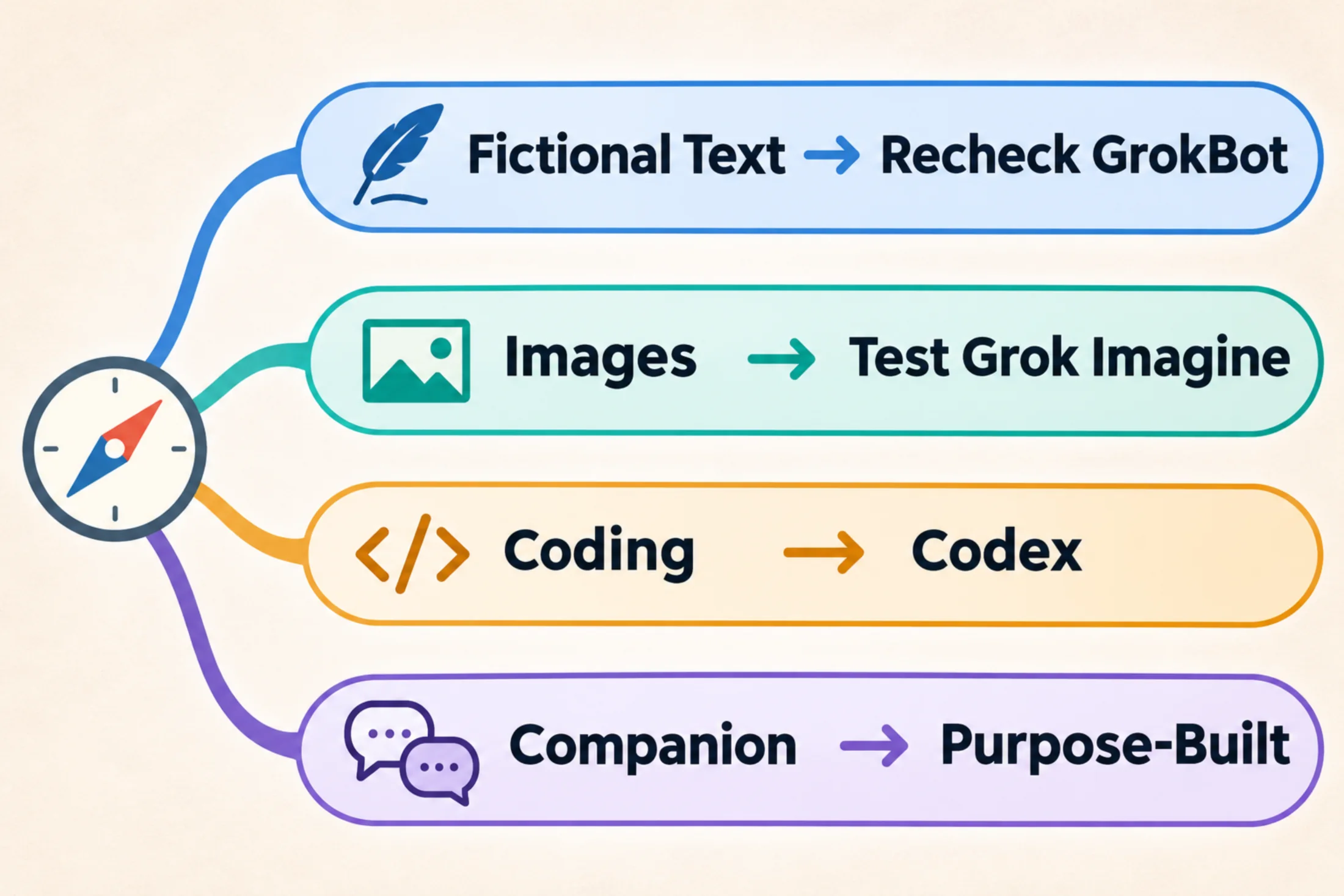
Choose the product surface by the workflow: text results do not automatically predict image, coding, or companion behavior.
Mistakes that produce misleading “NSFW AI” comparisons
Treating an acceptable-use policy as a list of enabled features is the first common mistake. Policies define boundaries; interfaces determine which capabilities users can access.
Another is assuming that access on one surface carries over to every related product. My GrokBot result does not automatically describe Grok chat, Grok Imagine, or an API deployment with an nsfw=decline guideline.
A refusal is also easy to misread as proof of model incapacity. It records the delivered product behavior, which matters to the user, but it does not reveal whether the limiting layer was the model, system instructions, a classifier, account controls, or another moderation component.
One successful response does not guarantee continued access. Models and products change, while account state, region, mode, and prompt wording can alter the result without a public announcement.
Finally, “adult-only” means that every depicted character is unambiguously 18 or older. It does not mean adults are excluded. Keeping that wording precise prevents a typo from reversing the intended boundary.
My practical recommendation
Define the output you need first: fictional prose, character roleplay, images, coding assistance, or an integrated companion experience. Test the exact surface you plan to use with several clearly adult, entirely fictional scenarios. Record the date, model, mode, region, settings, and response category, then choose the tool according to behavior you can reproduce now rather than a policy headline or an undated forum claim.
My finding is specific and dated: GrokBot generated adult-only fictional NSFW content in my November 19, 2026 test. Codex GPT-6.2 Sol and GPT-6.2 Astra refused the same class of requests and were ineffective for that particular purpose. Recheck all three before building a workflow around the result, since a product update, moderation change, account configuration, or regional rule may lead to a different response.
Find an effect for your next idea.
Browse the actual previews, choose your settings, and review the credit quote before you create.
Explore effects →